Full Pricing Breakdown for Boards & Property Managers
Every condo board eventually faces the same problem at budget season. Three security quotes come in, the hourly rates are nowhere close to each other, and nobody on the board can explain why. A $22 an hour bid and a $42 an hour bid can claim to cover the exact same lobby desk, and the board has no framework for judging which one actually protects the corporation.
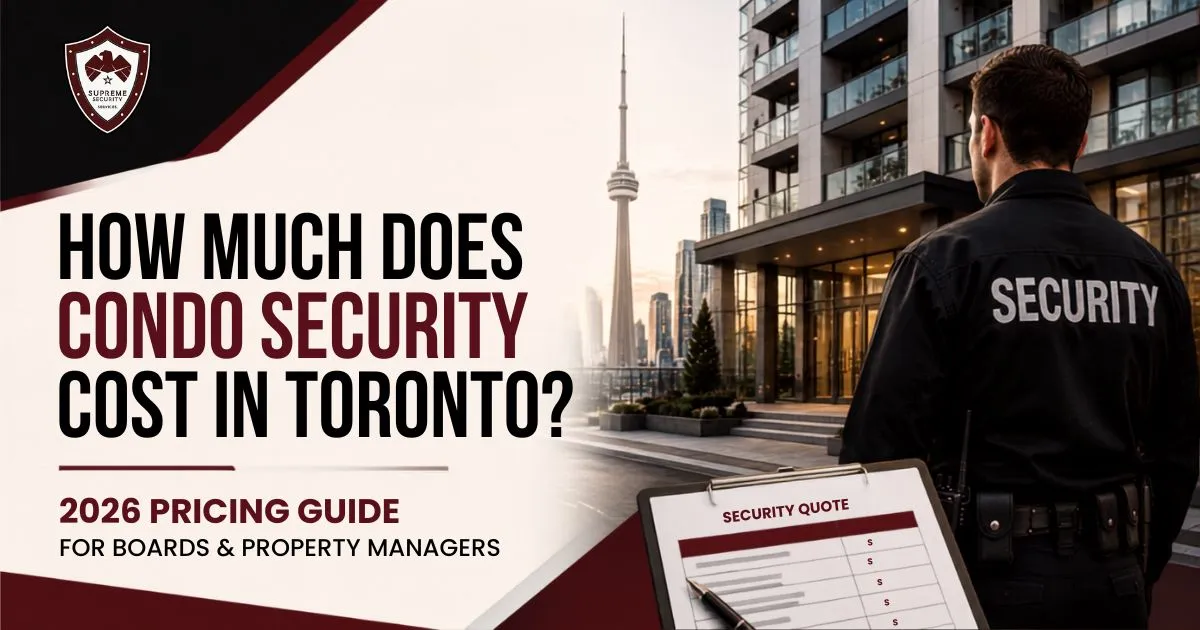
Condo security in Toronto and the GTA in 2026 typically costs between $25 and $45 per guard hour for standard concierge and static coverage, with downtown high-rise posts running higher and mobile patrol contracts priced separately by visit frequency. The rest of this guide breaks that number down by coverage type, building location, and what a legitimate bill rate actually has to include, so your board can read a quote instead of just guessing at one.
What Determines the Price of Condo Security in Toronto
Six variables move the hourly rate more than anything else: the building’s location within the GTA, the number of hours covered per week, the guard’s experience and training level, whether the role is concierge, static patrol, or mobile patrol, the length and terms of the contract, and whether the program includes a named supervisor.
A downtown Toronto tower with a 24-hour lobby desk and constant visitor traffic needs a different guard profile than a low-rise suburban building with a quiet evening shift. Location changes labour availability and risk. Building type changes what the guard is actually doing for eight or twelve hours at a time. A concierge security post, for example, blends customer service with access control, which commands a different rate than a guard whose job is limited to patrolling a parking structure.
Contract length matters too. A board signing a one-year agreement with clear renewal terms will often get a more stable rate than a board requesting month-to-month coverage with no commitment, since short-term arrangements carry more staffing risk for the vendor.
Toronto and GTA Hourly Rate Breakdown for 2026
Ontario’s general minimum wage sits at $17.60 per hour through September 2026 and rises to $17.95 per hour on October 1, 2026. That wage floor sets the base pay for entry-level guards, but it is not what your board pays. The bill rate you see on a quote has to sit well above that floor once licensing, insurance, supervision, and dispatch are built in. It’s worth being clear about that distinction upfront, since a guard’s personal wage (commonly $16 to $20 an hour for entry-level roles, according to industry pay data) and the bill rate your corporation is invoiced (starting at $25 to $28 an hour) are two different numbers, and a quote that sits close to the wage floor is a sign something in the middle has been stripped out.
| Guard Type | Typical Toronto/GTA Bill Rate | Best Suited For |
| Entry-level unarmed guard | $25 to $30/hour | Lower-traffic static posts, back-of-house patrol |
| Licensed concierge guard | $28 to $38/hour | Condo lobbies, visitor management, resident-facing roles |
| Senior or supervisory guard | $35 to $50/hour | Larger buildings, sites with elevated liability |
| Downtown Toronto premium post | $38 to $60+/hour | High-rise towers, high foot traffic, complex access control |
| Mobile patrol (basic visits) | $45 to $65/hour | Parking structures, construction sites, low-traffic overnight checks |
| Mobile patrol (advanced with reporting) | $60 to $85/hour | Sites needing documented incident reports and photo logs |
A guard working in a quiet suburban lobby in Milton or Whitby will not command the same rate as a guard managing a busy access-controlled tower near Yonge and Bloor. Downtown density and higher operating costs push the top end of the range up, while lower-traffic suburban buildings tend to land in the middle of it.
What a Legitimate Bill Rate Has to Cover
A properly built security bill rate is not the guard’s paycheque with a markup on top. It has to fund the guard’s wage, mandatory payroll costs, PSISA licensing compliance, liability insurance, uniforms and equipment, ongoing training, and 24/7 dispatch and supervision. Any quote that comes in barely above minimum wage has almost certainly stripped one or more of these out.
Every guard placed on your property must hold a valid licence under the Private Security and Investigative Services Act, 2005, commonly called PSISA. Getting that licence requires a 40-hour ministry-approved training course, a passed exam, current first aid certification, and a Criminal Record and Judicial Matters Check completed through a police service. A company charging a rate that cannot realistically cover all of this is either absorbing a loss or cutting a corner your board will inherit.
On top of the base wage, an employer legally owes Canada Pension Plan contributions, Employment Insurance premiums, and WSIB coverage for every guard on payroll. Add commercial general liability insurance, uniforms, radios, and a dispatcher answering calls around the clock, and it becomes clear why a serious concierge quote rarely lands near minimum wage.
Monthly and Annual Cost Examples for Common Coverage Models
Boards rarely think in hourly rates when they build a budget. They think in monthly and annual line items. The table below translates the hourly ranges above into what different coverage models typically cost once the math is done. These are calculated estimates based on the bill rates above, not quoted figures from any single vendor, so treat them as a planning starting point rather than a fixed price.
| Coverage Model | Weekly Hours | Estimated Monthly Cost | Estimated Annual Cost |
| Single guard, 24/7 concierge desk | 168 hours | $20,000 to $29,000 | $245,000 to $350,000 |
| Daytime and evening desk (7am to 11pm) | 112 hours | $14,500 to $17,000 | $174,000 to $204,000 |
| Weekend overnight coverage only | 24 hours | $3,100 to $3,700 | $37,000 to $44,000 |
| Nightly mobile patrol visits (basic) | 28 hours of active patrol time | $6,000 to $7,900 | $72,000 to $95,000 |
A 280-unit high-rise with a full-time lobby desk sits at the top of this table. A mid-rise building that only needs overnight coverage on weekends can budget closer to the bottom. Many GTA condo boards land somewhere between a full 24/7 post and a scaled-back schedule, combining daytime concierge hours with overnight mobile patrol checks instead of paying for a static guard through the quiet overnight hours.
Budgeting for Security Under the Condominium Act
Security falls under a condo corporation’s operating budget, not its reserve fund, and the board must approve that budget and circulate it to owners before the start of each fiscal year under the Condominium Act, 1998. The reserve fund exists for major capital repairs and replacements, while day-to-day security staffing is a recurring operating expense reviewed annually, usually in the lead-up to the AGM.
This matters for timing. A board renewing or shopping a security contract should start the RFP process well before the fiscal year end, not after the budget has already gone out to owners. The Condominium Authority of Ontario publishes guidance confirming that budgets must reflect the full amount required for operating expenses and reserve contributions for the year ahead, which means a security line item locked in after the fact can force an awkward mid-year variance explanation to owners.
Property managers who are members of the Association of Condominium Managers of Ontario generally recommend getting at least two comparable quotes before the AGM season, so the board has a defensible answer ready if an owner asks why the security line increased.
City-by-City Cost Differences Across the GTA
Rates are not flat across the region Supreme serves. Downtown Toronto and the immediate core carry the highest bill rates, driven by building density, higher local operating costs, and more complex access control needs. Security in Toronto proper tends to sit at the top of the range shown earlier in this guide.
Inner suburban markets including Mississauga, Vaughan, North York, and Markham typically fall in the middle of the range, with steady demand from growing condo stock keeping rates competitive without the downtown premium. Markets further out, including Hamilton and other outer GTA communities, generally see somewhat lower rates alongside wider variation between vendors, since fewer large firms compete actively in those areas.
A board comparing a Toronto quote against a Hamilton quote should not expect the numbers to match. The comparison that actually matters is whether two vendors quoting the same building in the same city are transparent about what their rate includes.
Red Flags in a Cheap Security Quote
A bill rate sitting only a dollar or two above Ontario’s minimum wage is the clearest warning sign a board will see during an RFP. It usually means one of three things is happening: the guard is unlicensed or under-trained, the company has no real insurance behind the contract, or the vendor plans to lose money and cut service quality once the contract is signed.
A board that accepts an underpriced bid does not just risk poor service. It takes on direct liability exposure, since a corporation can be held responsible for the actions of a contracted guard who was negligently hired or inadequately trained. A guard who mishandles an incident, fails to respond to an emergency correctly, or was never properly licensed can turn a routine claim into a costly legal matter for the corporation, not just the vendor.
Ask every bidder for a written breakdown of what the hourly rate includes. A vendor unwilling to show how the rate splits between wage, statutory payroll costs, insurance, and supervision is not being transparent with your board.
In-House Versus Contracted Security: A Straight Cost Comparison
Some boards consider hiring security staff directly instead of contracting a firm, believing it removes a markup. The comparison rarely favours the in-house route once every cost is counted.
| Cost Factor | In-House Guard Staff | Contracted Security Firm |
| Base wages | Board pays directly | Included in bill rate |
| CPP, EI, WSIB | Board pays directly | Included in bill rate |
| Sick day and vacation coverage | Board must arrange replacement | Vendor supplies a substitute guard |
| Liability insurance | Board must carry its own policy | Vendor’s policy covers the guard |
| Training and licensing renewal | Board must track and fund | Vendor manages compliance |
| Billing | Multiple payroll and expense lines | One predictable monthly invoice |
The contracted model shifts staffing risk, insurance, and compliance tracking onto the vendor. For most residential corporations, that predictability outweighs the theoretical savings of running payroll directly, especially once a board accounts for the administrative time a volunteer director would need to manage guard staffing personally.
What to Ask For in a Condo Security RFP
A well-run RFP protects the board more than any single line item on the quote. Before signing anything, ask each vendor for a rate breakdown showing wage, statutory costs, and margin, proof of current liability insurance, their process for verifying guard licensing under PSISA, a written replacement guarantee for sick calls and no-shows, the frequency of supervisor site visits, and any rate escalation clause with a stated annual cap.
A vendor that answers all six questions clearly, in writing, is giving your board something to compare beyond price alone.
Comparing Three Quotes for a 280-Unit High-Rise
Consider a hypothetical 280-unit high-rise in North York reviewing three proposals for a single 24/7 concierge post. The first quote comes in at $22 an hour, roughly four dollars above minimum wage, with no rate breakdown provided. The second sits at $32 an hour with a full breakdown, a named site supervisor, and a documented replacement guarantee. The third comes in at $46 an hour from a firm promising a larger on-call response team the building does not need.
The board’s strongest option is usually the middle quote. The first carries real liability and service risk hidden behind a low number, while the third bundles capacity the building will rarely use. A defensible security budget rewards transparency over the lowest number on the page.
Frequently Asked Questions
How much does a security guard cost per hour in Toronto?
Most licensed guards in Toronto and the GTA bill between $25 and $45 an hour in 2026, depending on the role, location, and hours of coverage, with downtown high-rise posts and specialized patrol running higher.
How much does 24/7 concierge security cost for a condo building?
A single continuously staffed 24/7 concierge post typically costs between $245,000 and $350,000 annually, based on current GTA bill rates, though buildings that combine reduced hours with mobile patrol can budget significantly lower.
Why do security quotes vary so much for the same building?
Quotes vary because vendors differ in what the rate actually includes. A low bid often strips out proper insurance, supervision, or licensing compliance, while a properly built quote accounts for all of it upfront.
Is hiring security guards in-house cheaper than contracting a security company?
Rarely. Once payroll taxes, insurance, replacement staffing, and training compliance are counted, in-house staffing usually costs more than a transparent contracted rate and shifts significant administrative work onto the board.
Does condo security come out of the operating budget or the reserve fund?
Security is an operating expense under the Condominium Act, reviewed and approved annually as part of the corporation’s operating budget, separate from the reserve fund used for major capital repairs.
What should be included in a security company’s hourly bill rate?
A legitimate rate covers the guard’s wage, CPP, EI, and WSIB contributions, PSISA licensing compliance, liability insurance, uniforms and equipment, ongoing training, and 24/7 dispatch or supervisory support.
Getting a Rate Your Board Can Defend
A security budget line only causes problems at the AGM when nobody can explain how it was set. Supreme Security Services provides GTA condo boards with a fully itemized quote for concierge security, so your board sees exactly what is funding the rate before you sign anything. Reach out for a quote and get a number for your building instead of a generic range.