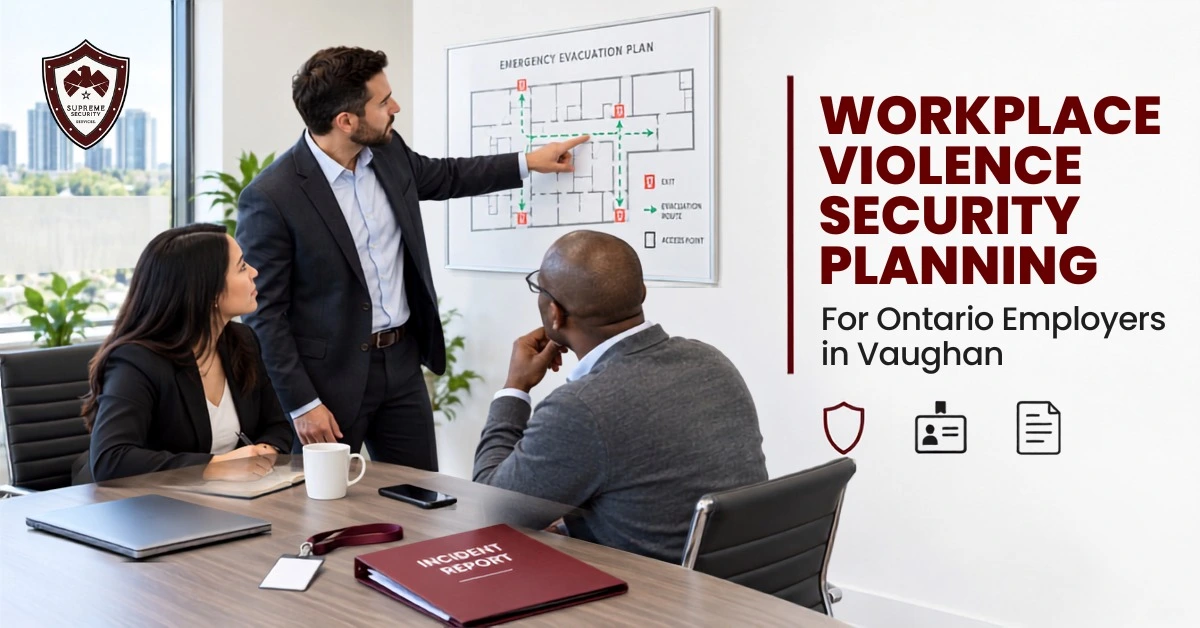
A workplace violence plan cannot live only in an HR binder. Workers need to know how to report a threat, how to call for immediate help and what to do when a visitor, customer, former employee or other person creates a risk of physical injury.
Physical security can support that plan. Controlled doors can limit entry. A duress alert can call for help. A trained guard can manage an assigned post, contact emergency services and write a factual incident report. None of these measures transfers the employer’s duties under Ontario’s Occupational Health and Safety Act.
This guide helps Vaughan employers connect workplace violence responsibilities with access control, reporting routes, escalation steps and guard duties. It gives general information, not legal advice. The facts of each workplace matter, and an Ontario health and safety professional or lawyer should review case-level compliance questions.
Emergency note: If violence is occurring, a person is in immediate danger or a crime is in progress, call 911\. York Regional Police lists 1-866-876-5423 for non-emergency assistance.
Is a Security Plan the Same as an Ontario Workplace Violence Program?
No. A workplace security plan may form part of the controls used within a workplace violence program, but it is not a replacement for the employer’s policy, program or risk assessment.
Ontario’s OHSA uses “workplace violence” for physical force that causes or could cause physical injury, an attempt to use such force, or a statement or behaviour a worker could reasonably interpret as a threat to use such force. Workplace harassment has separate legal requirements. Conduct can cross into workplace violence when it includes a threat, attempt or act of physical force.
The distinction matters because an employer cannot satisfy every duty by hiring a guard or installing cameras.
| Component | Main owner | Main purpose |
|---|---|---|
| Workplace violence policy | Employer | States the employer’s position and responsibilities |
| Workplace violence program | Employer | Puts reporting, assistance, risk controls and incident handling into operation |
| Risk assessment | Employer, with workplace participation where relevant | Identifies violence exposure arising from the workplace, work and work conditions |
| Physical security plan | Employer, facilities and security personnel | Defines access, observation, alert and response controls tied to identified risks |
| Guard post orders | Employer and security provider | State the guard’s site duties, limits, contacts and reporting steps |
Confirm Which Law Covers the Workplace
Most Vaughan workplaces fall under Ontario’s OHSA, but location alone does not decide jurisdiction. Banks, telecommunications businesses, air transportation and some interprovincial road, rail, marine, postal and courier operations fall under federal jurisdiction.
Federally regulated employers should review Canada Labour Code requirements instead of treating this Ontario checklist as their legal standard. The Government of Canada’s jurisdiction list can help with an initial check. Ask qualified counsel when jurisdiction is unclear.
Ontario OHSA Responsibilities Employers Should Map First
Security planning should start with the employer’s existing legal records. Doors, alarms, guards and cameras make more sense after the workplace has identified its duties and assessed its exposure.
Prepare and Review a Workplace Violence Policy
Every employer covered by the Ontario OHSA must prepare a workplace violence policy, regardless of workplace size. The employer must review the policy as often as necessary and at least once a year.
If six or more workers are regularly employed at the workplace, the policy must be in writing and posted in a conspicuous place or in a readily accessible electronic format. An electronic posting must be accessible to workers at the workplace, and workers must receive directions on where and how to find it.
For a workplace with five or fewer regularly employed workers, the policy does not necessarily need to be written. An inspector can still order a written and posted policy. These rules appear in section 32.0.1 of the Ontario OHSA.
Maintain a Workplace Violence Program
Every covered employer must develop and maintain a program that puts the violence policy into practice. Under section 32.0.2, the program must address:
- Measures and procedures to control assessed risks likely to expose a worker to physical injury.
- Measures and procedures for summoning immediate assistance when violence occurs or is likely to occur.
- Procedures for workers to report incidents to the employer or supervisor.
- How the employer will investigate and deal with incidents or complaints.
A guard’s post orders may support parts of this program. For example, post orders can state what a guard does after a duress alert. They do not take ownership of the employer’s policy, assessment or investigation process.
Assess the Risk of Workplace Violence
The employer must assess violence risks arising from the nature of the workplace, type of work and conditions of work. The assessment must consider both circumstances at that workplace and circumstances common to comparable workplaces.
The Ministry explains these terms in practical language:
- Nature of the workplace: Physical features such as entrances, exits, lighting, sightlines, counters and room layout.
- Type of work: Activities performed, the sector and the people workers interact with.
- Conditions of work: Hours, surrounding area, travel between locations, lone work and isolated work.
The assessment should not start with a shopping list. It should first establish who may face physical injury, where exposure could arise, when conditions change and what controls already exist.
Share the Assessment Results
The employer must advise the joint health and safety committee or health and safety representative of the assessment results. If the assessment is written, the employer must provide a copy.
If neither exists, the employer must advise workers of the results. When the assessment is written, workers must be able to request a copy or receive instructions on how to obtain one. Ontario explains these requirements in its workplace violence and harassment guide.
Sharing results does not mean publishing sensitive access details, alarm locations or personal information. The communication should give workers the information they need while protecting restricted security and personal records.
Reassess When Needed
The legal rule for the violence risk assessment is not simply “once a year.” The OHSA calls for reassessment as often as necessary so the policy and program continue to protect workers.
Ontario’s guide recommends reviewing the assessment at least annually. An earlier reassessment may be needed after:
- A violent incident, threat or serious near miss.
- A change in public access or operating hours.
- A new reception, loading, parking or employee entrance arrangement.
- A move to another building or floor.
- Changes to lone work, staffing or customer-facing duties.
- Worker, supervisor or JHSC feedback showing that a control does not work as intended.
Give Workers Information and Instruction
Workers need information and instruction suited to their jobs and the risks they may face. A policy acknowledgement alone may not prepare a receptionist, late-shift warehouse worker or retail manager to act under pressure.
Workers should know:
- How to summon immediate assistance.
- Where and how to report a threat or incident.
- What to do when the regular supervisor is unavailable.
- Which areas are restricted.
- How to respond to a duress alert or internal warning.
- What the employer does after receiving a report.
- Which steps belong to police, management, HR or security.
Assign Ownership Before Choosing Security Measures
Workplace violence concerns can cross HR, occupational health and safety, operations, facilities, privacy and security. Written ownership prevents two common failures: everyone assumes another department is handling the concern, or a guard receives duties that belong to the employer.
| Role | Planning responsibilities | During an incident | After an incident |
|---|---|---|---|
| Employer or senior leadership | Approve policy, program, resources and authority | Support emergency and management decisions | Review findings and authorize corrective action |
| HR or health and safety lead | Manage internal procedures, training and reporting routes | Receive reports and start the approved process | Coordinate the employer’s investigation and records |
| JHSC or health and safety representative | Receive assessment results and raise worker concerns | Take the role assigned by law and workplace procedures | Review relevant safety findings and proposed controls |
| Facilities or security manager | Manage doors, credentials, alarms, cameras and site procedures | Coordinate building controls and security contacts | Secure authorized records and correct control failures |
| Supervisor | Know reporting and immediate-assistance steps | Protect workers, call for help and notify assigned roles | Complete required reports and take assigned follow-up steps |
| Worker | Follow procedures and report concerns | Move to safety and summon help as trained | Provide factual information through the approved process |
| Contract guard | Follow post orders and lawful directions | Perform assigned safety, access, communication and emergency tasks | Submit factual notes and preserve authorized evidence |
The employer retains its OHSA responsibilities even when a third-party security company works on site.
Assess Workplace Violence Exposure at the Vaughan Site
Vaughan contains very different work settings within a short drive. A professional office near Highway 7 and Jane Street does not have the same entry pattern as a Woodbridge retail plaza or a Concord warehouse near Highway 400\. A VMC tower may share a lobby, elevator bank and parking garage with other occupants. A Maple workplace may have an exterior employee entrance used only during early or late shifts.
One corporate policy can cover several locations, but each site assessment should capture local conditions.
Walk the Site Through a Worker’s Day
Follow the worker journey from arrival to departure:
- Parking lot, transit stop or drop-off area.
- Public entrance and employee entrance.
- Reception, service counter or waiting area.
- Staff-only doors, elevators and stairwells.
- Meeting, interview or disciplinary-conversation rooms.
- Cash, product, records or restricted work areas.
- Washroom corridors and isolated rooms.
- Loading docks, yards and driver entrances where present.
- Closing route from workstation to exit and vehicle.
Ask what changes after normal business hours. A staffed lobby at 2 p.m. may become an unattended access point at 8 p.m. A shared underground garage may fall outside a tenant’s direct control. Record who owns each area before assigning corrective work.
Review Work Activities and Conditions
The assessment may need to examine:
- Regular interaction with customers, clients, patients, tenants or the public.
- Cash handling or control over goods and restricted records.
- Denying service, enforcing rules or asking someone to leave.
- Termination, discipline or other sensitive employment meetings.
- Lone work, isolated work and late shifts.
- Movement between buildings, vehicles or outdoor work areas.
- Delivery, contractor and temporary-worker access.
- Previous threats, violent incidents and near misses.
- Repeated access attempts by unauthorized people.
- Worker concerns about help arriving too slowly.
Use facts, reported conduct and work conditions. Do not label a person as a threat because of race, disability, age, gender, housing status, medical history or another personal characteristic. Human-rights, privacy and employment duties may also apply.
Examine Previous Reports Without Waiting for an Injury
A useful review includes more than injury records. Look for patterns in:
- Threatening calls, emails or messages.
- Aggressive customer or visitor incidents.
- Forced or repeated entry attempts.
- Duress alerts and alarm activations.
- Requests for escorts or help at closing.
- Reports that a worker could not reach a supervisor.
- Missing video, incomplete access logs or delayed incident reports.
- Situations where workers avoided reporting because the route was unclear.
Past events do not predict every future event. They can show where procedures, staffing or physical controls failed.
Match Physical and Procedural Controls to the Assessed Risk
The strongest control is not always the most expensive device. A locked door that staff routinely prop open has little value. A panic button that alerts nobody during lunch is not a working assistance procedure.
Each selected control should have an owner, operating rule, test method, backup and review date.
| Identified exposure | Possible control | Questions to test |
|---|---|---|
| Unrestricted public movement | Reception point, visitor sign-in or staff-only access zones | Can a visitor bypass reception? Who handles denied entry? |
| Revoked or lost credentials | Prompt credential cancellation and exception reporting | How quickly is access removed? Who confirms completion? |
| Worker cannot call for help safely | Duress button, radio, phone shortcut or monitored alert | Who receives it? What happens if that person does not answer? |
| Isolated customer meeting | Room layout, nearby assistance and scheduled check-in | Can the worker leave? Can another person hear or receive an alert? |
| Late-shift parking transition | Lighting review, controlled exit, check-in or risk-based escort | Who requests help? Which area belongs to the landlord? |
| Aggressive visitor at reception | Counter position, exit route, guard post order and escalation procedure | Can the worker withdraw without moving toward the person? |
| Repeated unauthorized entry | Door hardware, access records, guard coverage or remote monitoring | Is the issue detected, reported and assigned for follow-up? |
Access Zones and Credentials
Separate public, controlled and restricted areas. The written procedure should cover credential approval, issue, replacement, cancellation and temporary access.
Include contractors, former workers and employees who change roles. A credential system loses value when old permissions remain active or staff share cards to avoid inconvenience.
Where the assessment supports electronic control, link readers to your access control security services page. Do not describe the equipment as proof of OHSA compliance.
Visitor and Contractor Entry
A visitor log is only one part of entry management. The site may also need:
- Identity or appointment verification.
- A named host.
- Visible visitor identification where suitable.
- Limits on unescorted movement.
- A process for unexpected deliveries or contractors.
- A denied-entry rule.
- A clear escalation route when a person refuses to leave.
Reception staff and guards should not make improvised legal decisions. Post orders should state when to notify management and when to call police.
Immediate-Assistance Tools
The employer’s program must include measures and procedures for summoning immediate assistance when violence occurs or is likely to occur. The device is only the first link.
Document this chain:
- Who activates the alert?
- Who receives it?
- How is receipt confirmed?
- What does the receiver do?
- When does someone call 911?
- What backup applies if the device or receiver is unavailable?
- How often is the chain tested?
Do not publish duress-button locations or restricted response details on the public website.
Cameras and Privacy
Cameras may help an authorized person observe an entrance, verify an alert or preserve evidence. They do not replace reporting, assistance or response procedures.
Before adding cameras, define the business purpose, viewing area, authorized users, retention period and disclosure process. The Office of the Privacy Commissioner of Canada advises private-sector organizations to consider less intrusive options, limit camera range, restrict access to recordings and retain footage only as long as needed. Its public guidance does not cover every employee-surveillance issue, so workplace use may need separate legal review. See the federal video-surveillance guidance.
Create Clear Reporting and Immediate-Assistance Procedures
Workers should not need to interpret a long policy while an incident unfolds. Use short instructions for urgent action and a separate process for internal reporting.
| Situation | First route | Next internal step |
|---|---|---|
| Violence, immediate danger or crime in progress | Call 911 when safe to do so | Activate site alert and notify the assigned workplace contact |
| Non-urgent matter requiring police assistance | Call York Regional Police at 1-866-876-5423 | Record the police occurrence information if supplied and notify the assigned contact |
| Threat or concerning behaviour without immediate danger | Use the employer’s reporting route | Assigned person reviews and decides next steps |
| Access-control or security fault | Contact facilities, security desk or approved service contact | Apply the written backup procedure |
| Injury or need for medical help | Call emergency or medical assistance suited to the situation | Start employer injury and legal-notice procedures |
York Regional Police states that email should not be used to request immediate police assistance or file a crime report. The YRP contact page lists emergency and non-emergency routes.
What an Internal Report Should Capture
Record facts while they are fresh:
- Date, time and location.
- What the person said or did.
- Who was present.
- Any injury or request for medical help.
- Immediate actions taken.
- Police, guard, supervisor or emergency contacts made.
- Relevant access, alarm or video record references.
- Follow-up owner and due date.
Separate observation from conclusion. “The visitor struck the counter twice with a closed hand” is more useful than “the visitor was crazy.” Avoid medical or criminal labels unless a qualified authority has supplied the information and its use is lawful.
Do not promise total confidentiality. Explain that information will be handled through the employer’s process and shared only where needed for safety, investigation, corrective action or legal duties.
Build an Escalation Plan for Foreseeable Scenarios
Threatening Statement, Email or Message
Workers should preserve the message, avoid deleting related records and report it through the approved route. They should not be expected to decide whether the threat is credible or conduct their own inquiry.
The assigned employer contact can review urgency, contact police where needed, start the workplace process and consider temporary precautions. Security personnel may preserve authorized access or video records and receive a limited briefing needed for their duties.
Aggressive Visitor or Customer
The worker’s first goal is safety, not winning an argument or enforcing a policy alone. The procedure may direct the worker to create distance, move to a safer position, summon help and stop the interaction.
If a guard is present, post orders should state when the guard communicates, when the guard calls management, when police are contacted and when the guard withdraws. Avoid instructions that require an unsafe confrontation.
Unauthorized Entry
An unauthorized entry is not automatically workplace violence. It can become a serious safety concern when behaviour includes force, attempted force, a threat of force or another immediate danger.
The entry procedure should define who can deny access, who can cancel credentials, who reviews the access log and what happens when the person refuses to leave.
Domestic Violence That May Enter the Workplace
Under section 32.0.4 of the OHSA, an employer must take every precaution reasonable in the circumstances when the employer knows, or ought reasonably to know, that domestic violence may occur in the workplace and is likely to expose a worker to physical injury.
This requires sensitive case-by-case handling. A workplace plan may include temporary access changes, reception instructions, a safe arrival or departure arrangement, police coordination or other precautions suited to the facts. The targeted worker should be involved where possible, but the employer may still need to act to protect that worker or others.
Do not place personal details in a general guard log, group email or ordinary quote form. Share only what is needed for the assigned safety duty. Seek legal advice where privacy, family-law orders, employment decisions or personal medical information are involved.
Violence Occurring or Likely to Occur
Call 911 when there is immediate danger or a crime in progress. Workers and guards should follow trained site procedures, move away from danger when possible and avoid actions that place more people at risk.
Private security supports the response within its lawful authority and assigned duties. Police and emergency responders take control of police and life-safety functions when they arrive.
Define Security-Guard Duties and Limits in Post Orders
A vague instruction such as “handle workplace violence” is not a usable post order. Duties should state the trigger, authorized action, contact, backup and report requirement.
Duties a Guard May Be Assigned
- Verify staff, visitor and contractor access.
- Monitor an assigned entrance or reception area.
- Respond to duress alerts under the approved procedure.
- Call 911 or the YRP non-emergency line based on the event.
- Notify the employer’s assigned contact.
- Direct emergency responders to the correct entrance or area when safe.
- Observe and write time-stamped factual notes.
- Preserve authorized access, alarm and video references.
- Conduct assigned patrols and report access or safety faults.
- Support an approved escort or temporary coverage plan.
Duties That Should Stay Outside the Guard Role
A guard should not be assigned to:
- Decide whether the employer has complied with the OHSA.
- Conduct the employer’s HR or legal investigation unless separately qualified and lawfully appointed for that task.
- Decide discipline or termination outcomes.
- Diagnose a person’s mental health or medical condition.
- Promise secrecy to a reporting worker.
- Replace police, paramedics or other emergency responders.
- Use force or detention outside lawful authority, training and company policy.
- Share personal information beyond the authorized safety purpose.
Post orders should also identify the guard’s supervisor, employer contacts, 911 calling criteria, reporting format and procedure when a supervisor cannot be reached.
Handle Incidents, Evidence and Required Follow-Up
Put People Before Records
Move people away from danger, call emergency services and obtain medical help where needed. Evidence preservation matters, but it comes after immediate life and safety needs.
Preserve Authorized Records
After the area is safe, assign one role to protect relevant records. These may include:
- Guard notes and incident reports.
- Visitor records.
- Credential and door-event logs.
- Duress or alarm records.
- Authorized video clips.
- Relevant messages supplied through the employer’s process.
Track who accessed or copied a record. Keep it only through the approved retention and legal process. Do not circulate incident footage in group chats or use it for unrelated purposes.
Separate the Guard Report From the Employer’s Investigation
A guard report should state what the guard saw, heard and did. The employer’s investigation may examine other evidence, interview people, apply workplace policies and decide corrective action.
Treating a guard report as the full investigation can miss worker accounts, employment issues, prior reports and control failures.
Check Legal Notification Duties Promptly
Ontario’s Ministry guide states that a workplace violence incident involving a death or critical injury can trigger immediate notice to a Ministry inspector, the JHSC or health and safety representative, and the union if one exists. Written notice to a Ministry director is generally required within 48 hours.
The guide also describes a four-day written-notice duty to the JHSC or representative and union, if any, when a worker is disabled from usual work or requires medical attention because of workplace violence. Facts and current legal requirements should be checked at once with qualified counsel or the Ministry. Do not wait for the internal investigation to finish before checking notice deadlines.
Feed Findings Back Into the Plan
Ask:
- Did workers recognize the event and report it quickly?
- Did the assistance request reach the right person?
- Did the receiver acknowledge it?
- Were doors, cameras, radios and credentials working?
- Did staff and guards understand their roles?
- Did any instruction push someone toward danger?
- Were records complete and accessible to authorized reviewers?
- Does the assessment, program, training or post order need revision?
Assign each correction to a named role with a due date and verification step.
Train, Test and Review the Plan
Training should match the worker’s role. A front-desk employee may need visitor refusal and duress-alert instruction. A warehouse supervisor may need late-shift reporting and driver-entry procedures. A guard needs site contacts, post orders, restricted-area rules and report standards.
Test the Chain, Not Just the Device
A tabletop exercise can ask the team to walk through a reported threat, an aggressive visitor or an after-hours access attempt. Keep exercises controlled and suited to the workplace. Do not stage realistic violence without expert planning.
Check:
- Whether workers know the reporting route.
- Whether backup contacts work.
- Whether duress alerts reach an active receiver.
- Whether the receiver knows what action to take.
- Whether old credentials are removed promptly.
- Whether the guard has current post orders.
- Whether police and building contact information is current.
- Whether workers with accessibility needs can receive and act on instructions.
Record the date, participants, faults found, assigned corrections and retest date.
Use the Right Review Trigger
Keep the timing rules separate:
- Review the workplace violence policy as often as necessary and at least annually.
- Reassess violence risks as often as necessary for the policy and program to continue protecting workers.
- Review the plan after incidents, serious near misses, site changes or evidence that procedures are not working.
- Refresh worker and guard instruction when duties, risks, contacts or procedures change.
Select Security Coverage From the Assessed Need
Not every workplace needs a full-time guard. The right choice depends on the risk assessment, operating hours, public access, existing controls and the duties that need a human response.
| Coverage type | May fit when | Key limitation to examine |
|---|---|---|
| Fixed security guard | A site needs continuous entry management, observation or an assigned on-site response | One guard cannot be everywhere; breaks and backup coverage matter |
| Lobby or concierge security | A shared or public entrance needs credential and visitor control | Administrative duties must not distract from safety duties |
| Mobile patrol | A property needs scheduled or variable checks rather than continuous presence | The officer is not continuously on site |
| Remote video monitoring | An authorized operator needs to verify selected events and follow a call list | Camera view, connectivity and response ownership limit what can be seen or done |
| Electronic access control | The employer needs credential-based entry and usable door records | Technology cannot decide every human or emergency exception |
| Temporary on-site coverage | A documented short-term concern or workplace change calls for added presence | Set a review date, scope and exit criteria |
Ask vendors to quote the same written duties. This makes staffing, supervision, reporting, replacement coverage and exclusions easier to compare. Our guide on how to compare security guard quotes explains what to request beyond an hourly rate.
Workplace Violence Security Planning Checklist
Use this list for an internal gap review. It is not a compliance certificate.
Jurisdiction and Legal Records
- We confirmed whether Ontario or federal occupational health and safety law covers the workplace.
- We have a workplace violence policy.
- We reviewed the policy within the required period.
- We met written and posting rules that apply to our workplace.
- We have a workplace violence program with the required elements.
Assessment and Worker Participation
- Our assessment covers the workplace, work type and work conditions.
- It considers site-level and comparable-workplace circumstances.
- We documented relevant incidents, threats and near misses.
- We advised the JHSC, representative or workers of the results as required.
- We have a trigger for reassessment.
Access and Physical Controls
- Public, controlled and restricted areas are defined.
- Credential issue and cancellation have named owners.
- Visitor and contractor entry rules cover unexpected arrivals and denied entry.
- Workers have a safe way to call for immediate help.
- Assistance tools have a receiver, backup and test record.
- Camera use has a stated purpose, access rules and retention review.
Reporting and Escalation
- Workers know how to report an incident or threat.
- A backup route exists when the normal contact is unavailable.
- Staff know when to call 911\.
- York Regional Police non-emergency information is current.
- Domestic violence concerns have a sensitive, restricted reporting route.
- Incident reports separate facts from opinions.
Guard Duties
- Post orders define access, alert, contact and reporting duties.
- Guards know their authority and limits.
- Break, absence and replacement coverage are documented.
- Guard reports support but do not replace the employer’s investigation.
- Personal information is limited to the assigned safety need.
Review and Follow-Up
- Relevant evidence has an authorized custodian.
- Legal notice requirements are checked promptly after a serious incident.
- Corrective actions have owners and due dates.
- Worker and guard instruction is refreshed after material changes.
- Alerts, contacts and backup procedures are tested.
Frequently Asked Questions
Does every Ontario employer need a workplace violence policy?
Every employer covered by Ontario’s OHSA must prepare a workplace violence policy, regardless of workplace size. If six or more workers are regularly employed at the workplace, the policy must be written and posted conspicuously or in a readily accessible electronic format. An inspector can order a smaller workplace to put the policy in writing.
What must an Ontario workplace violence program contain?
It must cover controls for assessed risks likely to expose a worker to physical injury, immediate-assistance procedures, worker reporting procedures, and how the employer will investigate and deal with incidents or complaints.
Is a workplace violence risk assessment required every year?
The OHSA requires reassessment as often as necessary so the policy and program continue to protect workers. Ontario’s guide recommends reviewing the assessment at least annually, but employers should not treat that recommendation as the only trigger. Incidents, site changes or failed controls may call for an earlier review.
Does every Vaughan workplace need a security guard?
No. The risk assessment may support a fixed guard, lobby security, mobile patrol, remote monitoring, access control, procedural changes or a different mix. The selected measure should answer an identified exposure.
Can cameras satisfy Ontario workplace violence requirements?
No. Cameras may support observation, alert verification and evidence, but they do not replace the required policy, program, risk assessment, reporting route, immediate-assistance procedure or employer incident process.
What must an employer do when domestic violence may enter the workplace?
When an employer knows or ought reasonably to know that domestic violence may occur at the workplace and is likely to expose a worker to physical injury, the employer must take every precaution reasonable in the circumstances. The precautions depend on the facts and should protect privacy as much as safety permits.
What information can an employer share about a person with a violent history?
The OHSA duty is limited. The worker must be expected to encounter the person during work, and the risk must be likely to expose the worker to physical injury. The employer or supervisor must not disclose more information than reasonably necessary to protect the worker.
Can a security guard investigate a workplace violence complaint?
A guard can document observations, preserve authorized records and support the employer’s response. The employer remains responsible for the incident or complaint process in its workplace violence program. A guard report should not be treated as the complete employer investigation.
Can a worker refuse work because of workplace violence?
A worker may refuse work when they have reason to believe workplace violence is likely to endanger them. The OHSA sets a formal process, and limits apply to some workers in certain occupations. Employers and workers should consult the Ministry’s work-refusal guide for the procedure.
When should a Vaughan workplace call 911?
Call 911 when violence is occurring, someone is in immediate danger, urgent medical help is needed or a crime is in progress. York Regional Police lists 1-866-876-5423 for non-emergency assistance.
What information should an employer prepare for a security quote?
Prepare the workplace type, operating hours, public entry pattern, areas needing control, required guard or monitoring duties, reporting expectations and backup coverage needs. Use de-identified descriptions. Do not send sensitive worker information through an ordinary quote form.
Connect Employer Responsibilities With Site Security
A workable workplace violence plan connects the employer’s policy, assessment, reporting process and worker instruction with the controls present at the Vaughan site. Security coverage can support controlled entry, immediate-assistance procedures, observation, emergency communication and factual incident records. The employer still owns its OHSA duties.
If your assessment identifies gaps at a lobby, employee entrance, parking area, warehouse, retail property or commercial building, Supreme Security Services can review the security duties required at the site. Explore our commercial security services in Vaughan to discuss guard coverage, mobile patrols, access control or live video monitoring tied to a written scope.
Requesting security service does not replace legal review, the employer’s workplace violence program or any duty under the OHSA.