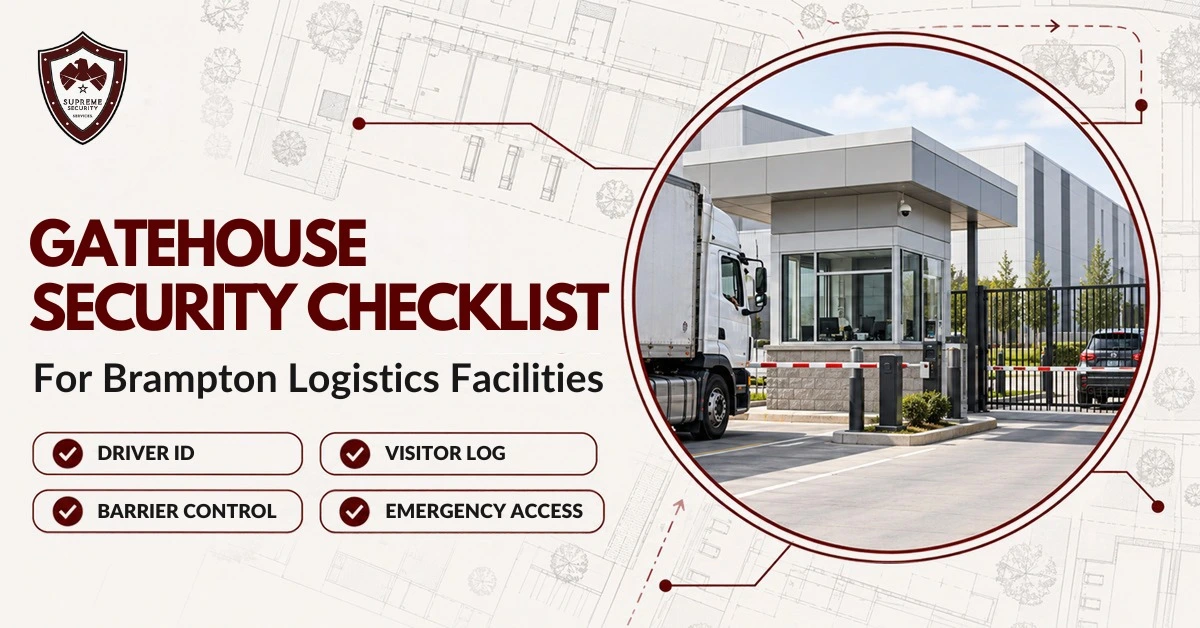
A gatehouse security checklist tells your gate staff what to verify, when to admit or hold a vehicle, and how to close the record before shift change. Brampton’s truck volume, driven by 12,000+ transportation and warehousing businesses in the city, means a vague “check ID and wave them through” process breaks fast. Use the six-step control loop below (Prepare, Verify, Decide, Route, Reconcile, Handover), match access rules to each visitor type, and never let a truck, badge, or key leave the property without closing the record.
What Is a Gatehouse Security Checklist?
A gatehouse security checklist is a written procedure that tells gate staff exactly what to confirm before a vehicle or person is admitted, which four decisions are available to them (admit, hold, deny, or emergency access), and what has to be recorded before that visit counts as closed. It is not a sign-in sheet. A sign-in sheet records that someone showed up. A checklist forces a decision at every stage of the transaction, from the barrier to the exit lane.
I have worked gates on both sides of Steeles Avenue, and the sites that get into trouble almost never have bad guards. They have no written answer for what happens when a trailer number does not match the appointment, or when a contractor’s badge is still checked out three days after the job finished.
Why Brampton’s Logistics Corridor Needs This More Than Most Cities
Brampton needs a written gate procedure more than most Ontario municipalities because it runs more freight through fewer square kilometres than almost anywhere else in the province. The City of Brampton’s 2023 Goods Movement Discussion Paper counts more than 12,000 businesses classified as transportation and warehousing within city limits, a direct result of Brampton’s position next to Toronto Pearson International Airport, CN’s intermodal rail yard, and the Highway 410 and Highway 407 corridors.
That intermodal yard is not a small detail. Brampton Economic Development identifies it as Canada’s largest CN intermodal terminal, and the city reports it moves more than 2,000 trucks a day. Properties along Steeles Avenue, Airport Road, and the Bramalea industrial belt routinely run one gate for commercial trucks, employees, contractors, and couriers at the same time. In my experience, that mix is exactly where a generic visitor-log approach falls apart during a Monday morning rush.
The Six-Step Gate Control Loop
Every gate transaction, whether it is a scheduled pickup or a first-time visitor, should move through the same six stages. Skipping straight from “Verify” to “Route” without a documented “Decide” step is the single most common gap I see on Brampton sites.
| Step | Gatehouse question | Record created |
| Prepare | Is this arrival expected? | Appointment, work order, or approved visitor request |
| Verify | Does it match the held record? | Identity, vehicle, purpose, and time check |
| Decide | Admit, hold, deny, or emergency? | Decision, reason, and approving role |
| Route | Where can they go? | Dock, waiting area, or escorted route |
| Reconcile | Has everything been returned? | Exit time, badge, key, vehicle status |
| Handover | What stays open? | Open holds, faults, and expected arrivals |
Who Has the Authority to Admit, Hold, or Deny a Vehicle?
A licensed guard’s authority comes from Ontario’s Private Security and Investigative Services Act, 2005 (PSISA), which requires anyone paid to guard property in Ontario to hold a current security guard licence issued by the Ministry of the Solicitor General. That licence authorizes the guard to control the barrier, compare records, and document the outcome. It does not authorize the guard to invent a shipping, HR, or contractor decision.
At Supreme Security Services, we write post orders that separate what the guard verifies from who owns the business decision behind it:
| Situation | Gatehouse role | Business decision owner |
| Routine truck arrival | Compare fields, record result, route the driver | Receiving or transportation team |
| Changed driver or trailer | Place on hold, contact the named approver | Shipping or transportation management |
| Visitor with no reachable sponsor | Hold at the marked waiting point | Host department |
| Contractor entry | Match work order, worker, and vehicle | Facilities or project owner |
| Employee credential failure | Hold or apply the written fallback | HR or access administrator |
Post orders need a primary and a backup contact for each row. “Call the office” does not work at 11 p.m. on a Friday shift.
What Should the Inbound Truck Check Actually Cover?
An inbound truck check should confirm that the appointment reference, carrier, driver credential, and unit numbers all match before the barrier opens, and it should take under two minutes for a routine, prepared arrival. A typical Brampton distribution gate compares:
- Appointment or dispatch reference
- Carrier name or approved carrier code
- Driver credential under the site’s policy
- Tractor and trailer unit numbers and plates
- Purpose (pickup, delivery, or service)
- Assigned dock, lane, or waiting area
- Seal status, where the shipment requires it
One matching field does not clear every other mismatch. If the trailer number is wrong but everything else checks out, that is still a hold, not an exception you wave through because the driver seems fine.
How Should Outbound Trucks, Empty Trailers, and Rejected Loads Be Handled?
The outbound gate has to close the movement record, not rubber-stamp a vehicle just because it is already inside the fence. Compare the driver, carrier, tractor, trailer, and release authority against the departure record, and hold anything that does not match until the named approver confirms it.
Seal condition matters here, and this is where a lot of Brampton sites get vague. If your facility, or a partner in your supply chain, is enrolled in the CBSA’s Partners in Protection (PIP) program, the seals used on that shipment must meet or exceed the ISO/PAS 17712 standard for high-security mechanical seals. A guard does not need to be a PIP compliance officer to do useful work here. They need to know that a missing seal, a seal number that does not match the paperwork, or a seal that looks re-applied gets reported and held, not waved through because the trailer “looks fine.”
Empty trailers, rejected freight, customer returns, and a tractor leaving without the trailer it brought in are not “no cargo, no problem” situations. Each needs its own record: what left, who authorized it, and what condition it was in.
How Do Visitors, Contractors, and Couriers Get Different Rules?
Visitors, contractors, and couriers need separate access rules because they carry different levels of risk and need different amounts of the property. Peel Regional Police’s business safety guidance recommends front sign-in, a visitor badge, and a sign-out with badge return, and that baseline still needs to be split by person type for a logistics site to actually work.
| Person type | Sponsor | Access | Exit check |
| Visitor | Named employee | Meeting or approved area, escorted | Sign-out and badge return |
| Contractor | Facilities or project owner | Named work zone only | Work-order closure, items returned |
| Courier | Receiving employee | Short-stay hand-off point only | Immediate exit, no yard access |
| Temporary worker | Staffing or HR contact | Assigned work area, expiring credential | Shift exit under the roster rule |
A courier dropping an envelope should never get the same yard access as a refrigeration technician with a two-hour work order. Giving every visitor type the same badge is how a small delivery ends up with more access than it needs.
How Should Keys, Badges, and Access Cards Be Controlled?
Every key, badge, card, or remote issued at the gate needs a unique identifier, a named holder, and a due-back time, or the cabinet is not actually controlled, it just looks locked. Record who issued it, what it opens, and who checked it back in. Restrict master keys and gate overrides to a short list of roles reviewed on a set schedule.
A missing low-access visitor badge and a missing master key are not the same emergency, and your post order should say so. For a master key, the response is immediate: notify the site lead, disable any linked access, and decide whether affected locks need review. A missing visitor badge from a two-hour meeting gets logged and watched. Treating both the same way either causes panic over nothing or, worse, calm over something serious.
What Happens When the Gate System Goes Down?
When the appointment system, card reader, or barrier fails, the gate needs a written manual mode instead of a guard improvising in real time. Decide in advance whether the gate fails open, fails closed, or moves to staffed manual control, because that answer depends on your specific equipment and emergency access needs, not on whatever seems safest in the moment.
Keep numbered paper forms in a protected location for exactly this situation. When a network or appointment system outage hits, the guard switches to the manual form, confirms arrivals through a phone number already on file rather than one supplied by the arriving driver, and reconciles every manual entry into the digital system once it is back online. Test this with a real drill at least once a year, not just when the system actually fails.
What Belongs on a Shift Handover Checklist?
A shift handover checklist has to cover every person and vehicle still on site, every open hold, and every issued key or badge that has not come back, reviewed out loud by both guards before the outgoing one leaves. A logbook nobody reads together is not a handover.
| Handover item | What to check |
| People on site | Visitor, contractor, or technician transaction numbers and expected exit |
| Vehicles on site | Tractor, trailer, or service vehicle status |
| Open holds | Who was contacted, and what is the next action |
| Issued items | Physical count of keys, badges, and remotes still out |
| Faults | Gate, reader, or camera issues and the temporary workaround |
The two guards sign or acknowledge the handover together. An unreturned key that “carries over” silently for three shifts in a row is the single most common finding when we audit a new Brampton account.
The Brampton Gatehouse Security Checklist
Use this as a working audit, not a publish-ready document, since a completed copy can reveal where your site is exposed.
Governance and authority
- A named manager owns the written gate procedure
- Primary and backup approvers are named for every exception type
- Post orders state exactly what the guard may hold, admit, or deny
Inbound and outbound traffic
- Appointment, carrier, driver, and trailer are checked against one authoritative source
- Mismatches move to a documented hold, not a judgment call
- Seal condition is checked and discrepancies are reported, not waved through
- Empty trailers and rejected loads have their own exit record
People and access
- Visitors, contractors, and couriers follow different, written access rules
- Every key and badge has a unique ID, holder, and due-back time
- Missing items trigger a written, role-specific response
Failure and handover
- A tested manual procedure exists for system, power, or network outages
- Both guards review open items together at every shift change
- Camera, gate, and reader faults have a named repair owner and deadline
Does Your Brampton Site Actually Need a Staffed Gatehouse?
Not every Brampton property needs a guard on the gate around the clock. Dedicated coverage is worth reviewing when exceptions happen daily, when one gate handles trucks, employees, and visitors at once, or when after-hours decisions depend on a manager who is not answering the phone. In my experience walking Brampton yards along the 410 and 407 corridors, the sites that call us are almost always the ones where the gate, appointment, and yard systems each show a different version of the same day.
Frequently Asked Questions
What should a gatehouse security checklist include?
It should cover approved-arrival verification, admit-hold-deny authority, visitor and contractor access rules, key and badge control, a manual procedure for system failures, and a shift handover that both guards review together before the outgoing guard leaves.
Does a Brampton warehouse gate guard need a licence?
Yes. Anyone paid to perform security guard duties in Ontario, including gatehouse work, must hold a valid Security Guard Licence issued under the Private Security and Investigative Services Act, 2005, and must be able to produce it on request.
What should happen when a truck arrives with no appointment?
Move the vehicle to a safe holding area away from the live lane if one exists, record the carrier and stated purpose, and contact the named transportation or receiving approver through a phone number already on file. Only admit the truck once that authority confirms it.
Should a gatehouse guard copy a driver’s licence?
There is no single rule that fits every site. The organization should set a lawful, specific purpose for any personal information it collects, following the PIPEDA fair information principles, and a guard should never photograph identification on a personal device. Get privacy advice specific to your business.
How is a courier different from a contractor at the gate?
A courier normally needs only a short-stay hand-off point with no yard or warehouse access, while a contractor needs an active work order, a named work zone, and an exit check for tools or removed property. Treating both the same way over-extends access to short visits.
What should a Brampton gate do if the barrier or reader fails?
Follow a pre-written manual procedure that states whether the gate fails open, closed, or moves to staffed manual control, use protected numbered paper forms to log arrivals, and reconcile every manual entry into the digital system once it is restored.
How often should a gatehouse procedure be reviewed in Brampton?
Review it on a set schedule, and again after any material change, such as a new carrier process, a traffic increase, a new visitor system, or a missed key. A procedure that has not changed since a system upgrade is usually out of date.
A Next Step, If This Is Where Your Gate Is At
If your Brampton gate is running on memory instead of a written procedure, that is usually fixable in one site walk. Supreme Security Services reviews gatehouse lanes, post orders, and handover records for warehouse and distribution properties across Brampton’s logistics corridor. Call 1-877-887-7110 to talk through what your gate actually needs.