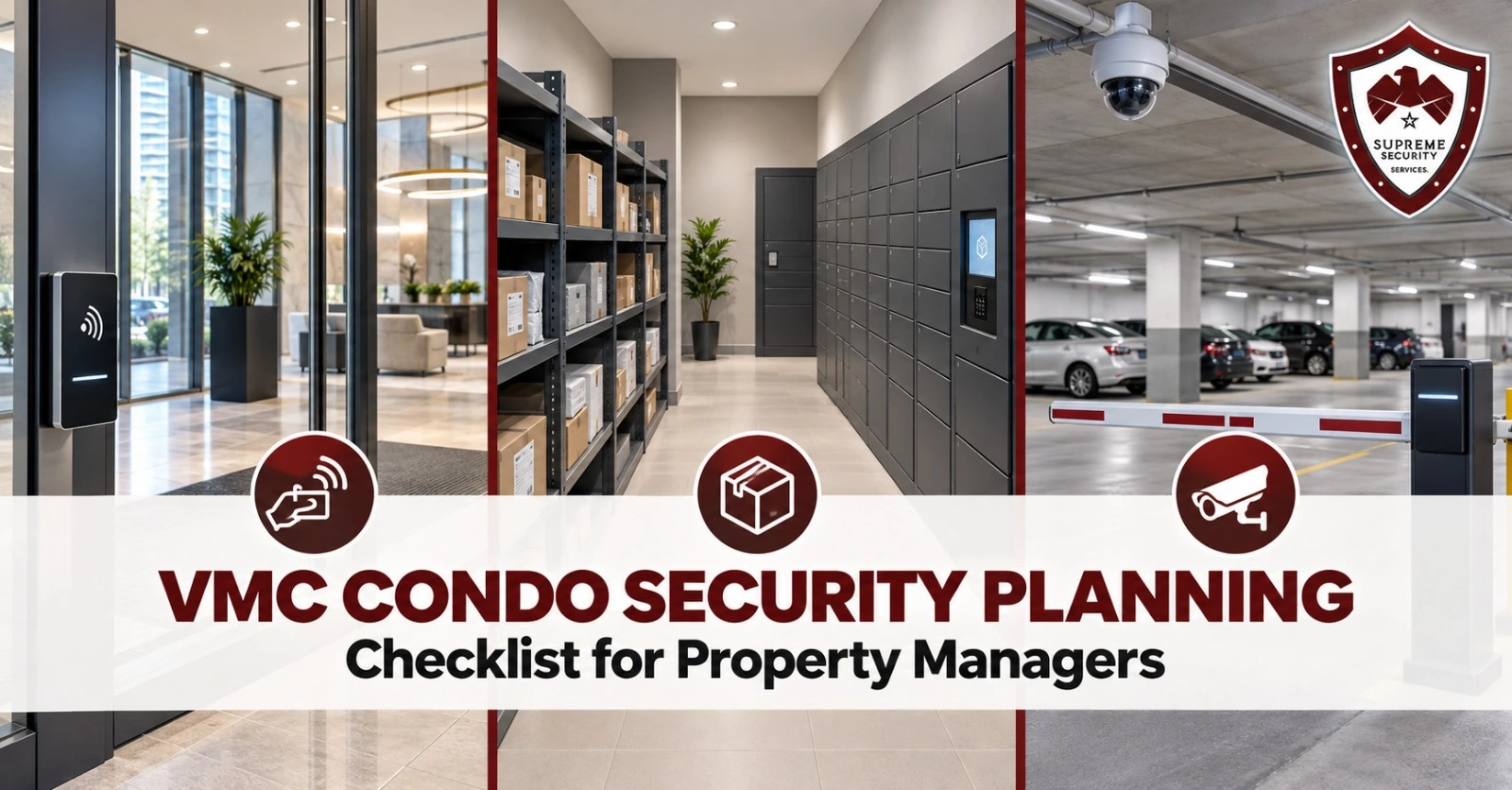
A condo security checklist should cover more than cameras, locks and a guard desk. It should show how residents, visitors, couriers, contractors and vehicles move through the property. It should also state who responds when a control fails.
That matters in Vaughan Metropolitan Centre. VMC is being built as Vaughan’s high-density, mixed-use downtown, centred on the subway, bus rapid transit and regional bus service. Residential towers sit within an area designed for employment, retail, civic activity and public space. A condo near Highway 7 and Millway Avenue may experience very different movement from a smaller residential building on a quiet street.
This checklist helps property managers examine those real operating conditions. Use it to record gaps, assign responsibility and prepare a clear brief for the condo board or a security provider.
It does not replace advice from legal counsel, fire-safety professionals, engineers, privacy specialists or qualified access-control contractors. Electrified locks, emergency release systems and life-safety equipment require the right technical review.
How to Use This Condo Security Checklist
Walk the property during more than one operating period. A lobby at 10 a.m. may look controlled. The same entrance can become harder to manage during the evening commute, a food-delivery rush or a scheduled move.
Rate each finding in one of three groups:
| Rating | What it means | Next step |
|---|---|---|
| Immediate attention | A current gap could expose people, restricted areas or building operations | Put a safe interim measure in place and assign an owner now |
| Planned correction | The control exists but needs repair, clearer instructions or approved spending | Record the work, decision owner and due date |
| Monitor | No urgent fault was found, but the item can drift or change | Set a test or review date |
Do not mark an item “passed” because equipment is installed. Test the operating result. A camera can be online but record an unusable angle. A fob system can work while hundreds of old credentials remain active. A lobby can have a concierge who was never given written instructions for a propped side door.
1\. Establish the Building’s Security Baseline
Start with the building, not a product list. VMC properties vary in height, age, retail connections, amenity use, parking layout and staffing. Their plans should vary too.
The City of Vaughan’s current VMC Secondary Plan describes a dense downtown organized around the VMC subway station, SmartVMC Bus Terminal and Highway 7 bus rapid transit. It also identifies residential, commercial, employment, cultural and civic uses. That context does not prove a particular security risk. It does mean a manager should examine how public activity meets private residential space at their own property.
Record the building’s operating profile
Write down the facts that affect entry and response:
- Number of residential entrances and separate retail entrances
- Lobby and front-desk hours
- Periods when no employee or guard is present
- Elevator and floor-access rules
- Parking levels, visitor parking and loading locations
- Parcel room, mailroom and food-delivery process
- Amenity hours and booking rules
- Move-in and move-out procedures
- Cleaning, maintenance and contractor schedules
- Shared areas with retail, office or public access
- Current security vendors and the part each one controls
Note traffic peaks instead of guessing. Observe the morning commute, the period after office hours, weekend amenity use and late-night deliveries. A property close to the subway or the Highway 7 corridor may have busy periods that do not match a standard office schedule.
Map public, controlled and restricted zones
Place each part of the property in one of three categories:
Public zones may include an exterior walkway, an open vestibule or a retail entrance.
Controlled zones may include the residential lobby, elevator lobby, parcel room, amenities and parking garage.
Restricted zones may include the management office, key room, camera equipment, electrical rooms, mechanical rooms and roof access.
Then trace every route between those zones. A strong front entrance means little if someone can enter through the garage and reach a residential elevator without another control.
Review incidents, complaints and failures
Use the records the corporation already holds. Review a reasonable period that reflects the property’s operations and record recurring issues such as:
- Unauthorized entry or attempted entry
- Doors found propped open
- Lost fobs that were not promptly cancelled
- Parcel complaints
- Garage tailgating
- Vehicle, bicycle or storage-room incidents
- Camera outages or missing recordings
- Intercom failures
- False alarms
- After-hours calls with no clear responder
- Reports that lack enough detail for follow-up
Do not turn anecdotes into crime statistics. The point is to find building-specific patterns: where events happen, when they happen and which control failed first.
Assign ownership
Every control needs an operating owner and a decision owner. They may not be the same person.
| Control | Daily owner | Approval owner | After-hours contact | Last test |
|---|---|---|---|---|
| Resident credentials | ||||
| Visitor entry | ||||
| Camera recordings | ||||
| Parcel process | ||||
| Guard or concierge instructions | ||||
| Incident communications |
Blank cells are findings. They show where responsibility can disappear between the board, property management, front-desk staff and several vendors.
2\. Audit the Lobby, Entrances and Access-Control Process
The lobby is where resident convenience meets building control. Review the full entry sequence rather than checking the main lock and moving on.
Test every entrance as a complete path
Check the main entrance, accessible entrance, side doors, garage entry, loading door and amenity exits. Ask:
- Does the door close and latch during normal use?
- Can a visitor pull it open after another person enters?
- Does the intercom reach the correct resident?
- How long does the door remain released?
- Can a secondary entrance bypass the front desk?
- Is a held-open alert noticed and acted on?
- What changes after the desk closes?
- Can staff see the entrance they are expected to manage?
Do not alter or repeatedly test an electrified exit in a way that affects life safety. If the concern involves a magnetic lock, fire-alarm connection, emergency release or stairwell re-entry, refer it to a qualified professional.
Reconcile fobs and credentials
An access system is only as accurate as its active-user list. Compare active credentials with current residents, employees and approved vendors.
Review the full credential cycle:
- Who approves a new fob?
- Is it assigned to one identifiable person or unit?
- What happens when it is reported lost?
- Is the old fob cancelled before a replacement is issued?
- Are move-out credentials cancelled on the agreed date?
- Do temporary contractor credentials expire automatically?
- Who holds master or high-access credentials?
- How often are dormant credentials reviewed?
Shared codes create a different problem. Once a code has passed among residents, cleaners, trades and delivery drivers, the manager may no longer know who can use it. Record where shared codes remain and why.
Observe tailgating and door propping
Watch how people behave during a busy period. Residents may hold a door for someone carrying a package. A mover may wedge an entrance open. A food courier may follow a resident into an elevator.
The answer is not an aggressive challenge at every door. Set a clear rule that staff can apply without putting themselves at risk. The rule may require resident confirmation, a call to management, observation from a safe position or an incident entry. Staff need to know where their authority ends.
Review the front-desk role
Write down what the concierge or guard must do. Avoid phrases such as “maintain security” without any task beneath them.
Useful post instructions address:
- Visitor confirmation
- Delivery direction
- Contractor sign-in
- Key and fob control
- Door-propping response
- Amenity access
- Garage and lobby patrols
- Emergency contacts
- Incident reports
- Shift handover
- Situations that require police, management or supervisor contact
A customer-service desk and a security post may share some tasks, but the title alone does not settle responsibility. The contract, site instructions, training and authority must match the work expected at that property.
3\. Control Deliveries, Parcels, Contractors and Move-Ins
“Delivery access” is not one activity. A parcel courier, food driver, cleaner, repair technician and moving crew create different entry needs.
Trace a parcel from the street to collection
Follow an ordinary delivery:
- Where does the courier stop?
- How is entry requested?
- Is the delivery purpose confirmed?
- Where may the courier go?
- Where is the parcel left?
- How is the resident notified?
- Who can enter the parcel area?
- What happens to an unclaimed or damaged package?
- Where is a missing-package report recorded?
An open pile beside the lobby desk may be easy for couriers and hard for staff to control. A parcel room can also fail if the door is routinely left open, access records are unclear or its camera does not show who removed an item.
Set a separate food-delivery rule
Food deliveries arrive in short bursts and often after normal management hours. Decide whether drivers wait in the lobby, use an intercom or travel to residential floors. Tell residents how the process works.
Check what happens when the resident does not answer. The driver should not receive a shared code or broad building access simply to clear the lobby. Late-night instructions should be just as clear as daytime instructions.
Time-limit contractor and vendor access
Cleaners, trades, real-estate representatives and service vendors may need access beyond the lobby. Record:
- Who approved the visit
- Permitted date and hours
- Areas the person may enter
- Credential issued
- Escort requirement, if any
- Keys or equipment provided
- Sign-out and credential return
- Contact if work runs late
A contractor fob issued for one project should not remain active years later. Review permanent vendor credentials and identify a named owner for each one.
Plan move-in and move-out days
Move days can hold a loading door open for hours. Movers, residents, cleaners and delivery vehicles may arrive together.
Reserve the loading route and elevator. State who watches the open entrance. Give the crew the boundaries of its access. At the end, check that doors latch, temporary credentials are returned and the departing resident’s access changes took effect.
4\. Inspect the Parking Garage, Loading Area and Storage Rooms
The vehicle gate is not the end of the garage review. Follow the route from the street to the residential floors.
Check vehicle entry and tailgating
Observe the gate during a busy arrival period. Does a second vehicle enter before it closes? Can a visitor reach the gate without speaking to anyone? Does the visitor system create a record the building can later understand?
Review resident instructions too. A gate cannot control tailgating if drivers routinely allow an unknown vehicle to follow them. Staff need a safe reporting step, not a direction to physically stop a vehicle.
Follow garage-to-building doors
Walk every path from parking to elevators, stairs, bike rooms and loading areas. Check whether a person who entered the garage can bypass the lobby and reach residential space.
Look for:
- Doors that fail to close or latch
- Doors propped for convenience
- Unmonitored stair connections
- Elevator access that differs from the written policy
- Blind turns near pedestrian doors
- Camera views blocked by pipes, signs or parked vehicles
- Call stations or help points that are not tested
Include areas that are easy to miss
Bike rooms, lockers, EV-charging spaces, car-wash bays and storage corridors can sit outside the main patrol route. Add them to the access map. Record who can enter, which door events are logged and how a resident reports a problem.
Lighting and sightlines matter for both people and cameras. Review dark patches, glare at vehicle entrances, damaged fixtures and stored material that blocks a view. Repeat the check when construction hoarding, snow storage or new equipment changes the space.
5\. Review Camera Coverage, Recording and Privacy
Cameras should have a stated job. “General security” is too vague to decide where a camera belongs, who may view it or how long a recording should remain available.
Give each camera a purpose
Create a camera list with location, direction and intended event. A lobby camera may need to show a person entering. A parcel-room camera may need to show an item being placed and removed. A garage camera may need to show a vehicle at a gate or a person at a garage-to-building door.
Avoid collecting more information than the stated purpose requires. The Office of the Privacy Commissioner of Canada advises private organizations to consider less intrusive options, limit collection, post understandable notice, restrict access and keep recordings only as long as needed for their purpose. Its video-surveillance guidance also recommends a written policy covering camera locations, fields of view, access, disclosure, retention and disposal.
Test saved footage, not just the live screen
Choose a recent, authorized test event and try to retrieve it. Confirm:
- The correct camera recorded
- Date and time are accurate
- The image is useful under day and night conditions
- The subject is not hidden by glare or an obstruction
- The recorder has not silently stopped
- Authorized staff can find the event without guesswork
- Exported footage can be handled securely
A wall of live images can create false confidence. The real test comes when management needs a specific event and the recording must be found quickly.
Control access, disclosure and deletion
Name the people allowed to view or export footage. Document why access was granted and when a copy left the corporation’s control. Requests from residents, insurers, lawyers or police should follow an approved process rather than an informal decision at the desk.
There is no single retention number that should be copied into every condo policy. The period should reflect the documented purpose, applicable requirements and qualified privacy or legal advice. Once footage is no longer required, deletion should be secure.
York Regional Police notes that camera images can assist investigations and maintains a voluntary Security Camera Registry. Registration tells police that cameras exist; it does not give them live access. A condo corporation should make any registration decision through its own approval and privacy process.
6\. Define Duties for Concierge, Guards, Patrols and Monitoring
Do not begin with “we need a guard.” Begin with the work that must happen, the hours it must happen and the response expected when something goes wrong.
Match the service to the task
An on-site post may fit a lobby that receives visitors and deliveries throughout a shift. Mobile patrol may fit a property that needs physical checks at selected times. Video monitoring may support defined camera events. Some buildings may need management changes before they buy more coverage.
Ask:
- Must someone remain at an entrance continuously?
- Are entry decisions frequent enough to require a staffed desk?
- Which areas require physical patrol?
- Are the main concerns concentrated in certain hours?
- What action follows a camera alert?
- Who attends if no employee is on site?
- Does the building need one service or a combination?
Write site-specific post orders
Post orders should name the doors, routes, records and contacts that apply to the building. They should cover routine work and exceptions.
Include:
- Start-of-shift equipment and key check
- Visitor and contractor rules
- Parcel duties
- Patrol route and frequency
- Areas that require an exception report
- Door or camera fault escalation
- Emergency and non-emergency contacts
- Resident-information boundaries
- Incident-report fields
- End-of-shift handover
Generic instructions invite different decisions from different staff members. Clear instructions give supervisors something concrete to check.
Review patrol records and handovers
A completed patrol record should say more than “all clear.” If a door was open, a light was out or a camera view was blocked, the record should show the location, time, action taken and person notified.
Shift handover must carry unresolved issues forward. The incoming person should know about a missing key, faulty gate, expected contractor or resident concern before taking responsibility for the post.
7\. Build Incident and Emergency Response Procedures
Security controls cannot remove every incident. A useful plan tells people what to do next without asking them to take unsafe action.
The Condominium Authority of Ontario’s emergency-planning guide sets out a practical cycle: assess vulnerabilities, develop the plan, test it, communicate it, then monitor and evaluate it. It also notes that boards and condo managers have distinct roles in preparing the corporation.
Create a contact tree
Separate urgent threats from non-urgent reporting. For an immediate threat to life or safety, call 911\. York Regional Police lists 1-866-876-5423 for non-emergency contact; confirm the number on the YRP website when preparing printed instructions.
The building list may also include:
- Property manager
- Board contact under the corporation’s policy
- Security supervisor or dispatch
- Fire-safety contact
- Elevator provider
- Access-control and camera vendors
- Emergency restoration provider
- Insurance contact
State who may call each contact and what information they should have ready.
Write short steps for likely scenarios
Create separate response cards for events such as:
- Unauthorized person in a controlled area
- Threatening or violent behaviour
- Garage tailgating
- Missing parcel complaint
- Access system outage
- Camera or recorder failure
- Door that will not secure
- Medical emergency
- Fire alarm or evacuation
Resident safety and emergency-responder directions take priority. Staff should not chase, detain or confront someone beyond their training, authority and safe working conditions.
Standardize incident reports
A useful report records:
- Date, time and exact location
- What the writer directly observed
- Who reported the event
- Description of people or vehicles when relevant
- Actions taken
- People contacted and at what time
- Witnesses
- Related camera or access records
- Open follow-up task
Separate observation from assumption. “The person entered behind a resident at 8:42 p.m.” is more useful than “a suspicious person broke in” when the writer did not see a forced entry.
Test, communicate and review
Walk staff through the plan. Test contact numbers. Confirm that the person receiving an escalation understands their role. Tell residents about the parts that affect them, such as delivery collection or emergency messages.
After an incident, hold a short review. What happened first? Which control worked? Where did the response slow down? Who owns the next action? Record the answers while the details are fresh.
8\. Turn Findings Into a Board-Ready Action Plan
A checklist is only useful if the findings reach a decision.
Separate operating corrections from capital work
Some gaps can be addressed through records, instructions or scheduling. Others need approved work by a qualified contractor.
Operating corrections may include:
- Cancelling old credentials
- Updating visitor rules
- Rewriting post orders
- Adding a missed patrol point
- Correcting the after-hours contact list
- Training authorized staff on footage retrieval
Capital or technical work may include:
- Replacing failed door hardware
- Changing an access-control system
- Adding or repositioning cameras
- Repairing a vehicle gate
- Altering a parcel room
- Correcting lighting or sightline problems
Do not buy equipment before the building has described the gap it must address.
Use one action register
| Finding | Current control | Priority | Interim action | Long-term action | Owner | Due date |
|---|---|---|---|---|---|---|
| Example: former vendor fobs remain active | Fob list exists but has no review owner | Immediate attention | Cancel identified credentials | Add quarterly reconciliation to management calendar | Property manager |
The board summary can stay short. List the main findings, immediate measures, decisions required, expected dependencies and person accountable for the next update.
Prepare a clear scope before requesting quotes
If the checklist points to outside security support, document:
- Property and areas covered
- Required post or patrol locations
- Days and hours
- Visitor, parcel and contractor duties
- Patrol expectations
- Report format
- Supervisor and replacement coverage
- Escalation contacts
- Start date and contract period
This gives providers the same job to price. It also helps the board compare duties and coverage instead of looking at one hourly number.
9\. Set the Next Review Date
Review the checklist on a set schedule and after a material change. A yearly review may be a useful management practice, but this article does not present it as a universal legal requirement.
Repeat the review after:
- A serious or repeated incident
- A new property-management or security provider
- Lobby, garage or parcel-room renovation
- Access-control or camera replacement
- A major change in retail or shared-space use
- New staffing hours
- A large set of unresolved audit items
Begin each new review with the old action register. Confirm what closed, what remains open and whether any interim measure quietly became permanent.
When to Request a Professional Condo Security Review
An internal walkthrough can expose obvious gaps. Outside support may be useful when:
- The building has repeated unauthorized entry despite working equipment
- Nobody can reconcile active credentials
- Several vendors control different parts of the system
- Guard or concierge duties are unclear
- Camera footage is missing when incidents occur
- The garage repeatedly bypasses lobby controls
- The board needs a defined scope for staffing, patrol or monitoring
- A renovation or occupancy change has altered movement through the property
Bring the building profile, access map, incident summary and action register to the review. That keeps the discussion focused on the property rather than a pre-set package.
Supreme Security Services supports property managers assessing front-desk coverage, access duties, patrol needs, reporting and after-hours response. Review the company’s Vaughan condo and property security services or request a site discussion based on your completed checklist.
Frequently Asked Questions
What should be included in a condo security checklist?
A condo security checklist should cover entrances, resident credentials, visitors, deliveries, contractors, parking, storage areas, cameras, staff duties, incident reports and emergency contacts. It should also give every finding a priority, owner and review date.
The checklist should reflect the actual building. A mixed-use VMC tower with retail access, a loading dock and several parking levels will not use the same plan as a small residential property.
How often should a condo security assessment be completed?
Set a regular review date and repeat the assessment after a serious incident, renovation, system replacement, staffing change or new use within the property. An annual review may work as an internal management cycle, but the right schedule depends on the building and any applicable obligations.
Who is responsible for a condominium security plan?
Responsibility may be divided among the condo board, property manager, employees, security provider and technical vendors. The corporation should document who operates each control, who approves changes and who responds after hours.
Contracts, governing documents and applicable requirements can affect those roles. Obtain qualified advice where authority is unclear.
Are cameras enough to secure a condo building?
No. Cameras can record or support observation, but they do not cancel old fobs, close a propped door, verify a visitor or decide who responds to an event. Camera coverage works best when it is tied to access rules, trained staff, incident reporting and a clear response step.
How long should condo camera footage be retained?
There is no one retention period that fits every condo. The corporation should document why it records, how long footage is needed for that purpose, who may access it and how it is deleted. Privacy and legal advice may be needed before setting or changing the period.
Does every VMC condo need a full-time security guard?
No. The decision depends on building traffic, entry decisions, incident patterns, existing controls, response expectations and budget. One property may need a staffed lobby during busy hours. Another may need clearer management procedures, selected patrols or monitored camera events.
How can a condo reduce garage tailgating?
Review gate timing, resident instructions, visitor entry, lighting, camera views and every garage-to-building door. Observe a busy arrival period and record what staff or residents are expected to do when an unknown vehicle follows them.
No single device fixes the full route. The gate, pedestrian doors, elevators and response procedure must work together.
What should a property manager prepare before requesting a security quote?
Prepare the building profile, access map, required coverage hours, post locations, visitor and delivery duties, patrol areas, incident summary, reporting needs and escalation contacts. Ask each provider to quote the same duties and periods so the comparison is meaningful.
Use the Checklist to Set the Next Priority
Complete the walkthrough, place each finding in a priority group and name the person responsible for the next action. Small gaps such as an old vendor fob or unclear after-hours contact can matter just as much as a large equipment project.
If the review points to a staffing, patrol, monitoring or response gap, take the records into a site discussion. A clear brief leads to a clearer decision, and gives the board something concrete to approve, question or revise.