Most condo boards in the GTA pay for one type of coverage while believing they bought another. A property manager signs a contract for “concierge security,” then an incident at the front desk exposes a worker with no PSISA licence and no legal authority to act. The difference between a concierge and a security guard is not a branding choice. It is a legal distinction set out in Ontario’s Private Security and Investigative Services Act, and it changes what your provider can lawfully do, what your building is exposed to, and what you should be paying per hour.
Concierge Security or Security Guard?
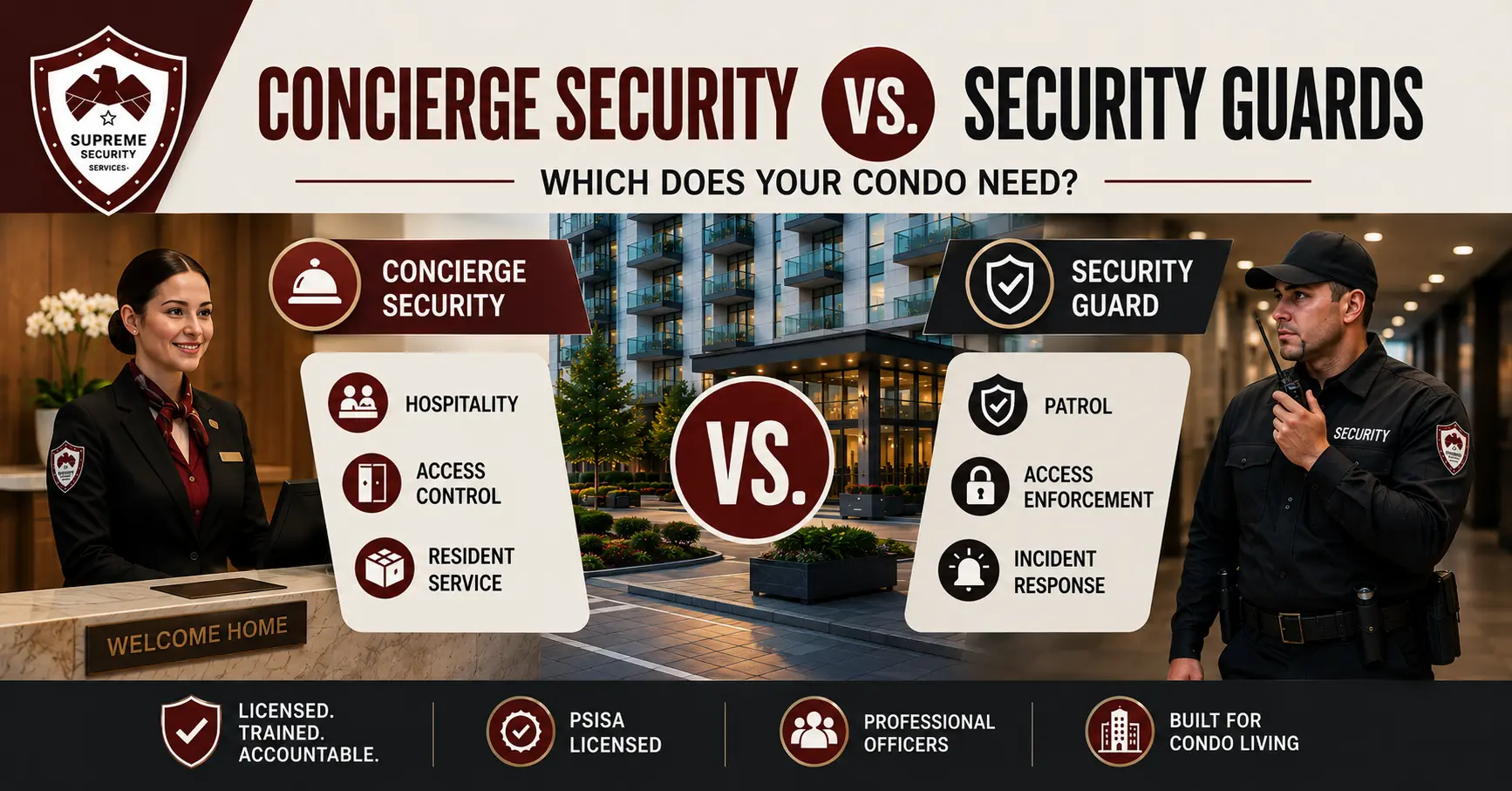
A concierge security officer holds an Ontario PSISA licence and is trained to combine front-desk hospitality with security duties, including access control and incident response. A standard security guard holds the same licence but focuses on protection, patrol, and enforcement rather than resident-facing service. Both roles are licensed. Their day-to-day priorities are what set them apart.
A traditional concierge, without a security licence, is a different position entirely. This person greets residents, logs packages, and answers phones. They hold no authority to control access, question a visitor, or respond to an incident beyond calling 911 as any bystander would. Many GTA condo contracts blur this line, and boards often assume “concierge” automatically means “licensed.”
Why Concierge and Security Are Interchangeable
Vendors use “concierge” and “security guard” as near-synonyms because the same officer frequently performs both jobs in a single shift. A licensed guard greets residents at the desk during the day, then switches to patrol and access enforcement overnight.
This overlap causes two recurring billing problems for boards. Some buildings pay guard-level rates for a role that is really front-desk service with no security licence behind it. Others pay concierge-level rates while getting full guard duties, which undercuts the provider’s ability to staff the post properly. Neither outcome serves the corporation.
The Legal Line: What an Ontario PSISA Licence Changes
Ontario law draws the line by function, not by job title. Anyone whose duties include protecting people or property for pay must hold an individual licence under the Private Security and Investigative Services Act, 2005. A front-desk worker whose role stays limited to deliveries, resident communication, and visitor logging can legally operate without one.
The moment that same person starts controlling entry, verifying identity, or handling an incident, their role crosses into licensed security work. Getting this wrong is not a paperwork issue. Operating unlicensed security staff exposes both the vendor and the condominium corporation to regulatory penalties and civil liability if an incident goes wrong.
Ontario’s licensing standard requires roughly 40 hours of approved training, a ministry exam, a criminal background check, and current First Aid and CPR certification. Every guard assigned to your building should hold their own individual licence, visible while on duty, in addition to the agency’s business licence.
Licensed vs. Unlicensed Security Officers
A licensed officer can deny entry to an unauthorized person, document an incident in a format your corporation’s insurer or lawyer can rely on, and respond to an emergency using trained protocols rather than guesswork. They can also perform a citizen’s arrest under section 494 of the Criminal Code if they directly witness an indictable offence, though this authority is the same one available to any private citizen, not a police power.
An unlicensed front-desk worker cannot do any of this as part of their job function. They can call for help and report what they saw. Asking them to physically intervene, detain someone, or enforce a building rule puts your corporation on uncertain legal ground and puts that employee at personal risk.
Why This Distinction Matters for Your Board
A condominium corporation carries a statutory duty of care toward its residents, and the security model your board chooses is one of the clearest ways that duty gets tested. Under section 37 of the Condominium Act, 1998, directors must exercise the care, diligence, and skill a reasonably prudent person would exercise in comparable circumstances.
Ontario courts have a specific, on-point precedent here. In 3716724 Canada Inc. v. Carleton Condominium Corporation No. 375 (2016 ONCA 650), the Ontario Court of Appeal upheld a condo board’s decision to require a full-time security guard as a condition of approving changes to the common elements, applying what is known as the “business judgment rule.” The Court found the board had acted honestly, in good faith, and had turned its mind to a genuine security risk, which meant its decision was owed deference rather than second-guessed. The same reasoning applies to a board’s choice between concierge, guard, or hybrid coverage: a documented, good-faith process matters more than getting every detail perfect.
A board that never reviewed its security model, or that assumed “concierge” meant licensed coverage without confirming it, has a harder time showing that same diligence if an incident leads to a claim. Written post orders, individual licence verification, and documented incident reporting are what typically separate a defensible board decision from an indefensible one. The Condominium Authority of Ontario and ACMO both publish governance guidance that property managers can use to benchmark their current security program against.
Concierge Security and Security Guards Cost in the GTA (2026)
| Concierge Security | Standard Security Guard | |
| PSISA licence required | Yes, when duties include security functions | Yes, always |
| Primary focus | Resident service plus access control | Protection, patrol, enforcement |
| Typical post | Lobby, front desk | Patrol routes, entry points, amenity areas |
| Reports to | Property manager, resident-facing | Property manager |
| Typical GTA rate (2026) | Roughly $25 to $35 per hour | Roughly $28 to $45 per hour |
| Best suited for | Mid-to-large buildings with high foot traffic | Buildings needing active patrol, overnight risk, or incident response |
Rates climb for overnight shifts, statutory holidays, and buildings with elevated risk or luxury amenity programs. Most GTA contracts also bill statutory holiday hours at 1.5x to 2x the base rate, a line item that catches many boards off guard at renewal time.
Which Model Fits Your Building?
Three Common GTA Configurations
Concierge-only works for smaller buildings with low visitor traffic and minimal overnight risk, where the primary need is resident service and basic access logging.
A hybrid officer is a single PSISA-licensed guard trained in both concierge duties and security protocols. They handle deliveries and visitor announcements by day, then shift into patrol and incident response after hours. This is the most cost-efficient setup for mid-sized buildings, since the corporation pays one bill rate that covers both functions.
A dual-post model pairs a dedicated concierge at the desk during peak resident hours with a separately licensed guard on patrol or overnight coverage. Larger buildings with heavy amenity use, elevated overnight risk, or a luxury service standard tend to need this configuration.
A mid-rise Vaughan condo board reviewing its contract ahead of AGM season is a common example. The building had run concierge-only coverage for years, until a parking garage incident exposed that the front-desk staff had no authority to intervene and no incident report the board could hand to its insurer. Moving to a hybrid officer model closed that gap without doubling the labour bill, since the same licensed officer covered both the desk and the overnight patrol.
How to Decide Before Your Next AGM
Start by confirming what your current contract actually delivers. Ask your provider for individual PSISA licence numbers for every staff member on site, not just the agency’s business licence. Review your last twelve months of incident reports and ask whether a licensed officer would have changed the outcome. Then match the model to your building’s actual traffic and risk profile, rather than defaulting to whatever the previous board chose.
Supreme Security Services is a trusted Toronto security company providing PSISA-licensed concierge and security guard coverage for condos across Toronto and the GTA. Every GTA condo post is staffed with individually licensed guards trained through our in-house Supreme Academy and supported by 24/7 dispatch from our Concord monitoring station. If your board is reviewing its concierge or security contract before the next AGM, request a quote and we’ll walk you through how we structure hybrid and dual-post coverage for buildings across Toronto, Vaughan, Mississauga, and the wider GTA.
Frequently Asked Questions
Is a condo concierge in Ontario legally allowed to act as security?
Only if they hold an individual PSISA licence. A concierge whose duties stay limited to service tasks, such as packages and visitor logging, does not require one. The moment their role includes access control or incident response, licensing is mandatory.
Do I need a licensed security guard, or is concierge coverage enough for my condo?
It depends on your building’s traffic, overnight risk, and amenity use. Smaller, lower-risk buildings often manage with concierge coverage, while buildings with garage access, high visitor volume, or after-hours risk typically need a licensed guard or a hybrid model.
How much does concierge security cost per hour in Toronto and the GTA?
Concierge security in the GTA generally runs $25 to $35 per hour, while a standard licensed security guard runs $28 to $45 per hour. Overnight shifts, statutory holidays, and specialized coverage push rates higher.
What is a hybrid concierge and security model?
A hybrid model uses one PSISA-licensed officer trained in both front-desk hospitality and security protocols. They cover resident-facing duties during the day and shift into patrol or incident response after hours, under a single bill rate.
Who is liable if my condo’s front-desk staff mishandle a security incident?
Liability depends on the circumstances and the contract terms with your provider. The condominium corporation carries a statutory duty of care under the Condominium Act, 1998, while the security vendor typically carries indemnity insurance capped by contract. Courts have shown deference to a board’s staffing decisions when the board acted honestly and documented a genuine risk, so boards should confirm both licensing and documentation before an incident occurs, not after.
How do I switch from concierge-only to a hybrid security model?
Most GTA contracts require 30 to 90 days written notice to change vendors or restructure coverage. A well-planned transition typically takes 30 to 60 days and includes fob reprogramming, staff briefing, and a supervisor walkthrough of new post orders.