Tailgating, Package Theft, and Parking Crime
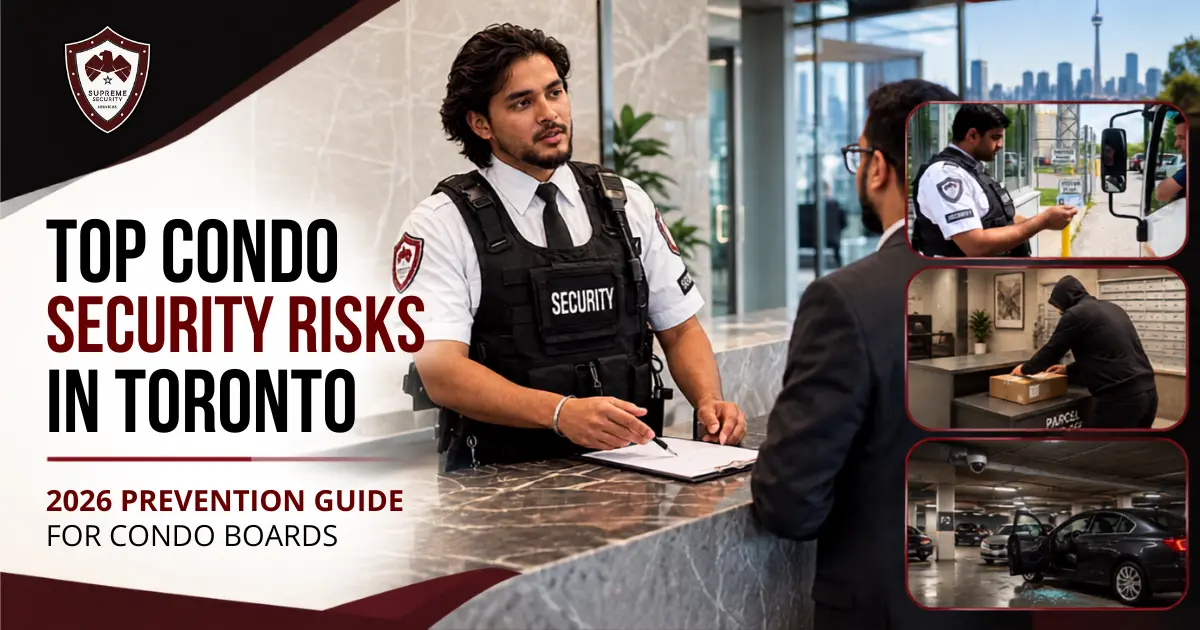
Property managers and condo boards across Toronto are dealing with a familiar cluster of complaints this year. Strangers slip in behind residents at the front entrance. Parcels go missing from the lobby before anyone claims them. Cars get broken into overnight in the parking garage. These three problems generate most of the security calls that land on a condo manager’s desk, and each one carries direct liability exposure for the board that oversees the building.
Toronto’s overall crime numbers improved through 2025, though the finalized annual figures came in a little different from the mid-December estimates that circulated early in the year. The Toronto Police Service’s full-year 2025 data shows break-and-enter incidents fell to 6,092, an 11 percent drop from 2024, while auto theft dropped to roughly 7,044 incidents, down 25.5 percent from the year before. One category moved in the opposite direction. Theft over $5,000 rose 6 percent year over year, the only major property crime category that climbed rather than fell. For condo buildings, where a single stolen vehicle, a package shipment, or a resident’s belongings routinely cross that $5,000 line, this is the trend that should shape 2026 budget and insurance conversations.
Tailgating, also called piggybacking, happens when someone without their own access credential follows an authorized resident or guest through a secured door before it closes. It is the single most common way unauthorized people get into a condo building, and it defeats fob-based access control because it exploits courtesy, not technology.
Tailgating and Unauthorized Building Access
Tailgating bypasses even a well-installed access control system because it relies on human behaviour rather than a security gap in the hardware. A resident holds the door for someone carrying groceries. A courier gets buzzed in and rides the elevator unaccompanied. A roommate’s fob gets shared with someone who was never registered with the property manager.
Once inside, an unauthorized person has the same access as any resident to hallways, stairwells, amenity spaces, and often the parking garage. Ontario condo living guides consistently flag hallway and elevator incidents as a direct consequence of unchecked tailgating, since a building’s interior offers privacy that a public street does not. Buildings without a staffed entrance or a visitor sign-in process have no reliable record of who entered, which makes any resulting incident harder to investigate and harder to defend in an insurance or liability claim.
The fix starts with reducing how often the door opens for unverified people, not just recording that it happened. A concierge security presence at the main entrance screens visitors and couriers before they reach the elevators, which removes the human courtesy problem that automated fobs cannot solve. Pairing that with access control and visitor management lets a board require ID sign-in for delivery drivers, run quarterly fob audits to catch shared or orphaned credentials, and set two-door entry sequencing so a second person cannot follow through before the first door locks.
Package Theft in Lobbies and Parcel Rooms
Package theft has actually improved nationally, but it remains a daily operational problem for high-density buildings that receive dozens of deliveries a day. A FedEx Express Canada survey found reported package theft among Canadians dropped from 16 percent in 2023 to 10 percent in 2024, though the average stolen parcel was still worth $113. A national decline does not mean condo lobbies are safe by default. Condo buildings concentrate parcel volume in one small, often unmonitored space, which is exactly the setup that makes a lobby more attractive to an opportunistic thief than a single house with one package on a porch.
The risk climbs sharply during the holiday shopping season, when delivery volume peaks and unclaimed parcels sit in open lobbies for hours before a resident gets home. A parcel room without camera coverage, or a lobby where couriers leave packages unattended by the mailboxes, creates a theft window that has nothing to do with the building’s overall crime rate and everything to do with how deliveries are handled.
Boards can close most of that window with three changes: a dedicated parcel room with real camera coverage, fob or code-controlled delivery lockers instead of open shelving, and a signature-required delivery policy during November and December. Live video monitoring covering the parcel room gives management usable footage the moment a resident reports a missing package, rather than a vague memory of who was in the lobby that day. A staffed concierge desk that logs and holds packages removes the open-shelf problem entirely.
Parking Garage and Vehicle Crime
Underground and enclosed condo parking garages are consistently the highest-risk zone in a condo property. They sit away from street activity and casual foot traffic, offer poor sightlines around pillars and parked vehicles, and hold dozens or hundreds of vehicles in one place, many worth well over the $5,000 threshold that Toronto’s property crime data shows is now climbing.
That risk shows up directly in insurance data. Insurance Bureau of Canada figures released in May 2026 show Toronto had the highest auto theft claims costs in Ontario in 2025 at $114.5 million, well ahead of Brampton at $43.2 million and Mississauga at $31.6 million. Garage doors and gates add a second layer of risk beyond the vehicles themselves. A slow-closing gate can leave a window where a second vehicle follows an authorized car through on one card scan, the same tailgating problem from the front lobby playing out in the garage. Visitor parking sections that connect to resident sections without a physical barrier compound the issue, since a stolen fob or a piggybacked entry gives access to the entire garage rather than one controlled zone.
Cameras alone record what happened. They do not stop it while it is happening, and a monitoring centre that spots an intrusion on screen still has to wait for someone to physically respond. Mobile patrol services covering overnight hours put a physical presence in the garage when it is quietest and most vulnerable. Combining that with parking enforcement for visitor stalls, tuned gate sensor timing, and camera coverage of blind spots around pillars and ramps addresses the garage as a system rather than relying on any single measure.
What the Condominium Act, 1998 Actually Requires From Your Board
Ontario law places direct legal responsibility for common element safety on the condo corporation itself, not on individual unit owners. Section 26 of the Condominium Act, 1998 deems the corporation to be the occupier of the common elements for the purpose of liability, while owners are deemed not to be occupiers of that shared space. In practical terms, when a tailgating incident, a theft, or an assault happens in a hallway, lobby, or garage, the corporation and its board carry the exposure, not the individual resident who happened to hold the door.
That exposure comes with a defined standard, not a vague expectation. Section 37 requires every director to act honestly and in good faith and to exercise the care, diligence, and skill that a reasonably prudent person would use in comparable circumstances. A board that has never reviewed its access control policy, never audited who holds a fob, or never documented a response plan for a break-in has a harder time showing it met that standard if a resident is harmed. The Condominium Authority of Ontario and its tribunal exist specifically to resolve disputes when governance falls short of what the Act requires.
Licensing matters here too. Any security guard working in a Toronto condo must hold a valid licence under the Private Security and Investigative Services Act, and a board that hires an unlicensed provider takes on liability it does not need to carry. This is also why insurance renewal conversations increasingly ask boards what physical security measures are in place. A documented, licensed security program is one of the more direct ways a board can demonstrate the standard of care Section 37 describes, ahead of AGM season when owners will ask what the board is doing about it.
Passive Measures vs. a Layered Security Approach
| Risk | Passive or Reactive Approach | Layered Professional Approach | Typical Outcome |
| Tailgating | Fob-only entry, no visitor log | Concierge screening, visitor sign-in, quarterly fob audits, vestibule cameras | Unauthorized entries stopped at the door, not discovered after the fact |
| Package theft | Open lobby drop-off, no camera coverage | Camera-monitored parcel room, delivery lockers, signature-required policy | Fewer disputed “missing package” claims and faster investigations |
| Parking garage crime | Cameras reviewed only after an incident is reported | Overnight mobile patrol, tuned gate sensors, visitor and resident zone separation | Incidents deterred or interrupted rather than only recorded |
A Prevention Checklist Your Board Can Act on This Quarter
- Run a fob audit and deactivate any credential not tied to a current resident or approved tenant.
- Require ID sign-in for couriers and contractors instead of open buzzer access.
- Add or reposition cameras to cover the parcel room, not just the main lobby entrance.
- Switch to signature-required or locker-based delivery before the December holiday surge.
- Have the garage gate’s closing sensitivity and timing reviewed to close any tailgating window.
- Add physical separation or clearer signage between visitor and resident parking sections.
- Schedule overnight mobile patrol coverage for the hours when the garage sees the least foot traffic.
- Confirm every guard on site holds a current PSISA licence and ask for proof before renewal.
Getting Your Building’s Security Program Ahead of 2026
Tailgating, package theft, and parking garage crime are not separate problems that need separate vendors. They are three symptoms of the same gap: an access point, whether a door, a parcel shelf, or a garage gate, that relies on a single passive measure instead of a layered one. Boards that address all three together, and document that they have done so, are in a stronger position for AGM season, insurance renewal, and the standard of care the Condominium Act actually requires.
If your building is due for a security review, Supreme Security Services can walk your board through where the current gaps sit and what a layered program would look like for your specific property. Request a quote to get started.
FAQ
What is tailgating in condo security?
Tailgating, or piggybacking, is when someone without their own fob or access credential follows an authorized resident or guest through a secured door. It is the most common way unauthorized people enter a condo building.
How can condo boards prevent package theft in the lobby?
A camera-covered parcel room, delivery lockers instead of open shelving, and a signature-required policy during high-volume periods close most of the theft window. A staffed concierge desk that logs incoming packages removes it almost entirely.
Are condo parking garages a common target for theft in Toronto?
Yes. Garages are isolated from street activity, have limited natural surveillance, and hold a high concentration of vehicles, which insurance data shows makes Toronto the highest auto theft claims market in Ontario.
Is a condo corporation liable if a resident is robbed in a hallway or elevator?
Under Section 26 of the Condominium Act, 1998, the corporation is deemed the occupier of the common elements for liability purposes, not individual owners. This places direct exposure on the board when an incident happens in a shared space.
Do condo security guards need to be licensed in Ontario?
Yes. Every guard working in a Toronto condo must hold a valid licence under the Private Security and Investigative Services Act. Boards should confirm licensing before signing or renewing a security contract.