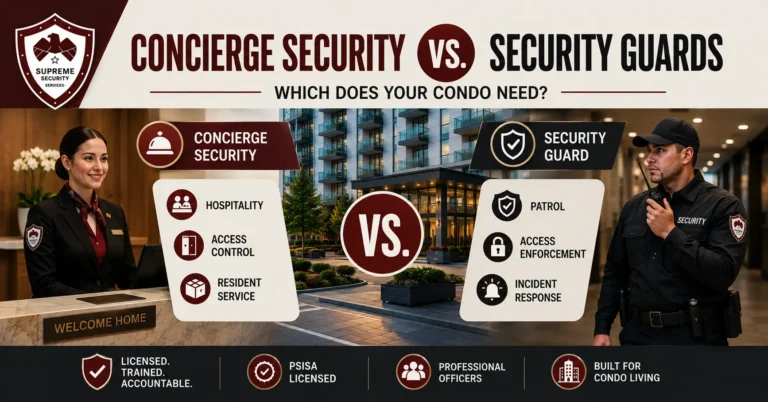
Concierge security is front-desk security staffed by a licensed security officer rather than a receptionist. The same person greets residents, screens visitors, logs deliveries and patrols common areas, and because they hold an Ontario PSISA licence they can also act when something goes wrong. It is one role doing two jobs that most buildings used to split in two.
What Is Concierge Security?
A concierge security officer is a licensed security guard whose post is the front desk. They carry the same Ontario licence as any other guard, and they are trained to handle the resident-facing side of a building as well: answering questions, announcing visitors, accepting parcels, booking the amenity room.
The distinction that matters to a condo board is legal, not cosmetic. A receptionist can log a visitor. A concierge security officer can refuse one entry. When an incident happens in the lobby at 2am, a receptionist calls for help and a concierge officer is the help.
Concierge Security Meaning in Plain Terms
The concierge security meaning most GTA vendors work to is simple: a licensed guard on a service post. You will see the same job advertised as a security concierge, a concierge officer or a front-desk guard, and in practice those titles all describe the same role. What changes between providers is not the label but whether the person holding it is licensed.
Ask ten property managers what concierge security means and you will get ten slightly different answers, which is part of why comparing quotes is so difficult. The version that holds up: a PSISA-licensed officer who runs front-desk hospitality and building security as a single role, instead of the corporation paying for a receptionist and a separate guard.
Concierge Security Guard Meaning and Importance
A concierge security guard is not only a protector of the property. They are the first face people see when they walk into a building, which means the role combines safety with service in a way a patrol post does not.
In an upscale apartment building they might watch the camera feed, greet residents by name and sign for packages. In a hotel they confirm that only registered guests get past the lobby while giving directions and handling small requests. In both cases their presence improves security and convenience at the same time.
The hard part of the role is staying professional and approachable at once. Enforcing a strict access policy has to sit alongside a welcoming lobby. Concierge security guard duties usually include checking identification, keeping a visitor log and raising security concerns, all without making residents feel policed.
That combination is why buildings that need both safety and service staff the desk this way.
Key Duties of a Concierge Security Guard
A concierge security guard holds the building’s safety standard while delivering the service residents expect. The job is not only to watch the property but to make sure everyone entering it is accounted for.
Core Responsibilities
- Access control: confirming that only authorised residents, guests and contractors get in.
- Greeting residents and guests: answering questions, announcing visitors, giving directions.
- Visitor and delivery logging: keeping a written record a property manager can search later.
- Incident response: acting on fire alarms, medical emergencies and disturbances using trained protocols.
- Common-area patrols: walking the garage, amenity floors and stairwells between desk duties.
- Written reporting: documenting incidents in a format a board, manager or insurer can rely on.
Come home late and the officer on the desk will greet you, confirm who you are and let you up. That small interaction is the whole point of the post: a resident feels looked after, and an unauthorised visitor meets someone whose job is to stop them.
Concierge vs Security Guard: What Sets Them Apart?
The difference between a concierge and a security guard is not the licence, because a licensed concierge officer and a patrol guard hold the same one. Both carry the same obligation to keep people safe. What separates them is where they stand and what they spend the shift doing.
Key Differences
- Focus: a standard guard patrols, observes and enforces. A concierge officer runs the desk, so visitor management and resident service take up much of the shift.
- Manner: a patrol guard is deliberately visible and formal. A concierge officer has to be approachable, because residents deal with them every day.
- Skills: patrol work leans on physical security and observation. Concierge work adds communication, de-escalation and front-desk administration.
A concierge officer might check a guest in, verify their identity and direct them to the right elevator bank. A patrol guard working the same building might instead be walking the parking garage looking for the people who should not be there.
It is also worth separating both of those from an unlicensed concierge, which is a different position entirely. That person greets residents, logs packages and answers the phone. They hold no authority to control access, question a visitor or respond to an incident beyond calling 911 as any bystander would. A lot of GTA condo contracts blur this line, and boards often assume concierge automatically means licensed.
| Compared on | Concierge security | Traditional static guard | Front-desk receptionist |
|---|---|---|---|
| Primary focus | Resident experience plus security | Security only | Administrative support only |
| Training | PSISA plus hospitality and de-escalation | PSISA licensing only | No security training |
| Legal authority on an incident | Yes, licensed to act | Yes, licensed to act | No, has to call security |
| Resident interaction | Constant, first point of contact | Minimal to none | Constant, but no security role |
| Typical setting | Condo, apartment, or office lobby | Warehouses, construction sites, retail | Any office front desk |
A receptionist answers phones and books the amenity room. A concierge officer does that too, but is licensed under the PSISA, trained in de-escalation and legally positioned to act when something in the building goes wrong. A receptionist calls security. A concierge officer is security.
The Legal Line: What an Ontario PSISA Licence Changes
Ontario draws the line by function, not by job title. Anyone whose duties include protecting people or property for pay must hold an individual licence under the Private Security and Investigative Services Act, 2005. A front-desk worker whose role stays limited to deliveries, resident communication and visitor logging can legally work without one.
The moment that same person starts controlling entry, verifying identity or handling an incident, the role crosses into licensed security work. Getting this wrong is not a paperwork problem. Operating unlicensed security staff exposes both the vendor and the condominium corporation to regulatory penalties, and to civil liability if an incident goes badly.
Ontario’s licensing standard requires roughly 40 hours of approved training, a ministry exam, a criminal background check and current First Aid and CPR certification. Every guard assigned to a building should hold their own individual licence, visible while on duty, on top of the agency’s business licence.
Licensed vs Unlicensed Security Officers
A licensed officer can deny entry to an unauthorised person, document an incident in a format a corporation’s insurer or lawyer can rely on, and respond to an emergency using trained protocols rather than guesswork. They can also perform a citizen’s arrest under section 494 of the Criminal Code if they directly witness an indictable offence, although that authority is the same one available to any private citizen and is not a police power.
An unlicensed front-desk worker cannot do any of this as part of the job. They can call for help and report what they saw. Asking them to physically intervene, detain someone or enforce a building rule puts the corporation on uncertain legal ground and puts that employee at personal risk.
Skills Needed for a Concierge Security Guard
The post needs security judgement and genuine service skills in the same person, which is why it is harder to staff well than a patrol route.
What the Role Demands
- Attentiveness: reading the lobby constantly and spotting a problem before it escalates.
- Clear communication: dealing with residents, guests, trades and staff politely and without ambiguity.
- Problem solving: handling the situation nobody wrote a post order for, without dropping the access standard.
- Written accuracy: an incident report is only useful if it holds up months later.
A resident loses their keys at midnight. The officer verifies who they are, lets them into their unit and writes it up, without creating a hole in the building’s access control. That is the skill the role is actually paid for.
Concierge Security and Security Guard Costs in the GTA (2026)
| Concierge security | Standard security guard | |
| PSISA licence required | Yes, when duties include security functions | Yes, always |
| Primary focus | Resident service plus access control | Protection, patrol, enforcement |
| Typical post | Lobby, front desk | Patrol routes, entry points, amenity areas |
| Typical GTA rate (2026) | Roughly $25 to $35 per hour | Roughly $28 to $45 per hour |
| Best suited for | Mid-to-large buildings with high foot traffic | Buildings needing active patrol, overnight risk, or incident response |
Rates climb for overnight shifts, statutory holidays, and buildings with elevated risk or luxury amenity programs. Most GTA contracts bill statutory holiday hours at 1.5x to 2x the base rate, a line item that catches a lot of boards off guard at renewal.
Which Model Fits Your Building?
Three Common GTA Configurations
Concierge only works for smaller buildings with low visitor traffic and minimal overnight risk, where the real need is resident service and basic access logging.
A hybrid officer is a single PSISA-licensed guard trained in both concierge duties and security protocols. They handle deliveries and visitor announcements by day, then move into patrol and incident response after hours. This is usually the most cost-efficient setup for mid-sized buildings, because the corporation pays one bill rate covering both functions.
A dual post pairs a dedicated concierge at the desk during peak resident hours with a separately licensed guard on patrol or overnight coverage. Larger buildings with heavy amenity use, elevated overnight risk or a luxury service standard tend to need this.
Why This Distinction Matters for Your Condo Board
A condominium corporation carries a statutory duty of care toward its residents, and the security model a board chooses is one of the clearest places that duty gets tested. Under section 37 of the Condominium Act, 1998, directors must exercise the care, diligence and skill a reasonably prudent person would exercise in comparable circumstances.
Ontario courts have an on-point precedent. In 3716724 Canada Inc. v. Carleton Condominium Corporation No. 375 (2016 ONCA 650), the Court of Appeal upheld a condo board’s decision to require a full-time security guard as a condition of approving changes to the common elements, applying the business judgment rule. The Court found the board had acted honestly, in good faith, and had turned its mind to a genuine security risk, so its decision was owed deference rather than second-guessed. The same reasoning applies to a choice between concierge, guard or hybrid coverage: a documented, good-faith process matters more than getting every detail perfect.
A board that never reviewed its security model, or that assumed concierge meant licensed coverage without confirming it, has a harder time showing that diligence if an incident turns into a claim. Written post orders, individual licence verification and documented incident reporting are usually what separate a defensible board decision from an indefensible one.
Why Concierge Security Guards Are a Growing Trend
Condo boards increasingly treat the front desk as part of a building’s identity rather than a line item to minimise. Luxury apartments, hotels and corporate offices ask for concierge coverage because they want the access standard without a lobby that feels like a checkpoint.
The same pattern shows up in premium retail and event venues, where the operator needs someone who can hold a perimeter and still talk to the public. An officer who knows a resident’s name, and their dog’s name, changes how that resident describes the building when a unit goes up for sale, which matters more than most boards expect.
Choosing the Right Concierge Security Guard Services
A few things worth confirming before signing anything:
- Individual licence numbers: ask for the PSISA licence of every officer posted to your building, not just the agency’s business licence.
- Experience in both halves of the role: security and hospitality, not one with the other bolted on.
- Reporting you can actually use: ask to see a sample incident report before you need one.
- Coverage when someone calls in sick: ask how the post gets filled at 5am on a Sunday.
If your board is reviewing its contract, Supreme Security Services provides PSISA-licensed concierge security services for Toronto and GTA condos, staffed by individually licensed guards and supported by 24/7 dispatch from our Concord station.
Frequently Asked Questions
Are security and concierge the same thing?
Not automatically. A concierge security officer holds an Ontario PSISA licence and can act on an incident. A plain concierge, with no security licence, handles service tasks such as packages and visitor logging and has no authority to control access or intervene. The job title alone does not tell you which one you are buying.
Is a condo concierge in Ontario legally allowed to act as security?
Only if they hold an individual PSISA licence. A concierge whose duties stay limited to service tasks does not require one. The moment the role includes access control or incident response, licensing is mandatory.
Do I need a licensed security guard, or is concierge coverage enough for my condo?
It depends on the building’s traffic, overnight risk and amenity use. Smaller, lower-risk buildings often manage with concierge coverage, while buildings with garage access, high visitor volume or after-hours risk typically need a licensed guard or a hybrid officer.
How much does concierge security cost per hour in Toronto and the GTA?
Concierge security in the GTA generally runs $25 to $35 per hour, while a standard licensed security guard runs $28 to $45 per hour. Overnight shifts, statutory holidays and specialised coverage push rates higher.
What is a hybrid concierge and security model?
A hybrid model uses one PSISA-licensed officer trained in both front-desk hospitality and security protocols. They cover resident-facing duties during the day and move into patrol or incident response after hours, under a single bill rate.
Who is liable if my condo’s front-desk staff mishandle a security incident?
Liability depends on the circumstances and on the contract terms with the provider. The condominium corporation carries a statutory duty of care under the Condominium Act, 1998, while the security vendor typically carries indemnity insurance capped by contract. Courts have shown deference to a board’s staffing decisions when the board acted honestly and documented a genuine risk, so confirm licensing and documentation before an incident, not after.
How do I switch from concierge-only to a hybrid security model?
Most GTA contracts require 30 to 90 days written notice to change vendors or restructure coverage. A planned transition usually takes 30 to 60 days and includes fob reprogramming, staff briefing and a supervisor walkthrough of the new post orders.