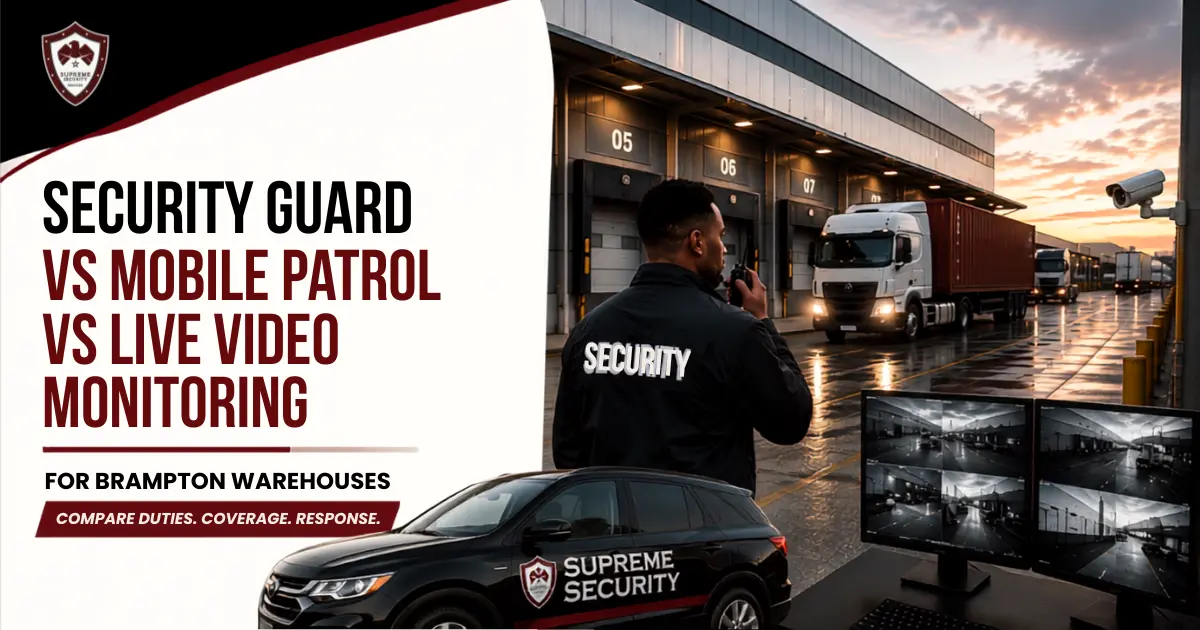
An on-site guard fits a Brampton warehouse when drivers, visitors, or contractors need a real-time access decision. Mobile patrol fits scheduled or randomized physical checks when the site sits quiet for long stretches. Live video monitoring fits active review of specific camera views when the need is visual awareness, not a hands-on check. Most Brampton warehouses along the 410, 407, and Airport Road corridors end up running two of the three at once, split by time of day, because a single warehouse rarely has just one kind of risk.
What Is the Difference Between a Security Guard, Mobile Patrol, and Live Video Monitoring?
A security guard is a licensed person stationed at a fixed post for set hours to make access decisions and handle incidents in person. Mobile patrol is a licensed officer who drives or walks a defined route to inspect a property at scheduled or randomized times, then leaves. Live video monitoring is active review of defined camera feeds by a person watching for agreed events during set hours, distinct from a recorder that only saves footage for later.
I have worked all three roles on Brampton warehouse contracts. The mistake I see most often is buyers picking one service and expecting it to cover a duty it was never built for. A guard cannot watch every dock door and remain at the gate. A patrol car cannot see what happens the moment after it leaves. A camera cannot walk over and check a lock.
Start With the Four Requirements Test
The right coverage type comes from four separate questions, not from property size or a generic recommendation. Answer these four before comparing a single quote.
| Requirement | Question to ask | Coverage that fits |
| Human presence | Must someone speak with people, check credentials, or decide access throughout the period? | On-site guard |
| Physical verification | Must someone touch, open, close, or inspect a part of the property? | On-site guard or mobile patrol |
| Visual detection | Must defined camera views be reviewed for activity while no one is nearby? | Live video monitoring |
| Response ownership | Who attends, contacts management, or takes action after something is verified? | Guard, patrol officer, or site contact under written instructions |
Does the Duty Require Continuous Human Presence?
A duty needs continuous human presence when someone has to make a decision that cannot wait for the next scheduled visit. A live driver queue at a Brampton gate is the clearest example. Someone has to check names, compare paperwork, call an authorized contact, and handle a rejected or early arrival, and none of that can sit until 10 p.m. when the patrol car swings by.
“Continuous” has a limit worth naming. A guard posted at your gatehouse gives continuous coverage of that post during the contracted hours. It does not mean the same person also watches every dock door and walks the fence line at the same time. If your gate procedures need more detail, our gatehouse security checklist for Brampton logistics facilities breaks down exactly what a gate post should verify.
Does the Duty Require a Physical Check?
A physical check is any task that needs a person’s hands or eyes up close, and a camera cannot substitute for it. Testing a lock, inspecting a damaged door, walking a fence line, or opening an approved access point all need someone standing there. A camera can show that a door looks open. It cannot tell you whether the latch is broken.
The remaining question is frequency. A check needed constantly through a shift points toward an on-site guard. A check needed at set points in the day points toward patrol.
Does the Site Need Active Visual Review?
Active visual review means a person is watching defined camera feeds during set hours, not that a recorder is running in the background. Recorded CCTV helps after an event already happened. Live monitoring adds a person reviewing agreed views for defined events while the event may still be unfolding.
That coverage only works where the camera actually shows something useful. A parked trailer, a dirty lens, or a changed storage layout can hide the exact spot that matters, which is why camera readiness gets its own section further down.
Who Owns the Response?
Every detection method is useless without a named person who acts on it. If a monitoring operator sees an unauthorized vehicle, who takes the call at 2 a.m.? If a patrol officer finds a cut fence, do they call the warehouse manager or attend alone? If the first contact does not answer, who is next?
Write the response chain down before you sign anything. A camera alert with no attendance plan is a notification with nowhere to go. A guard with two competing duties will eventually leave one of them uncovered.
What Can an On-Site Security Guard Cover at a Brampton Warehouse?
An on-site guard is the strongest fit when a Brampton warehouse needs continuous interaction, judgment, and a person physically present at a fixed post. Anyone doing this work in Ontario needs a current Security Guard Licence under the Private Security and Investigative Services Act, 2005, issued by the Ministry of the Solicitor General, and must be able to produce it on request.
Where an On-Site Guard Fits Well
A guard assigned to a Brampton warehouse typically handles:
- Staffing a gatehouse or controlled entrance during agreed hours
- Checking driver, visitor, and contractor information under site instructions
- Contacting authorized staff when an arrival does not match the record
- Observing traffic and activity from the assigned post
- Logging arrivals, departures, exceptions, and incidents
- Running selected foot rounds when post duties allow it
- Supporting emergency communication within the guard’s training and post orders
These duties earn their place when activity is frequent. A driver arriving at a Bramalea distribution centre at 6 a.m. should not wait for the next scheduled patrol pass to get checked in.
What One Guard Cannot Do at the Same Time
A guard is not property-wide coverage just because that person is on site. Picture a guard posted at a busy gate off Steeles Avenue. If they step away for a twenty-minute yard round, who checks the next arriving driver? If they stay at the gate, who inspects the rear fence line?
Post orders have to answer that, not leave it to the guard’s judgment mid-shift. The fix might be camera support for the guard’s blind spots, a second person for peak hours, or a patrol unit handling the physical checks the guard cannot reach. Buyers also need to plan for break coverage, shift change handoffs, unfinished incidents, and how far the guard is allowed to move from their post. A guard does not replace working locks, lighting, or camera maintenance either. Those are separate controls doing separate jobs.
Signs an On-Site Guard Should Lead the Plan
Start with an on-site post when:
- Drivers, contractors, or visitors arrive throughout the coverage period
- Access decisions cannot wait for the next scheduled visit
- Someone must remain at a defined entrance
- Exceptions happen often enough to need live communication
- Physical observation is needed through most of the shift
See our uniformed security guards page for the duty types that can be written into post orders.
What Can Mobile Patrol Cover at a Brampton Warehouse?
Mobile patrol gives a warehouse a physical security visit at scheduled or randomized times without placing one officer at the property around the clock. It fits repeat checks, lock inspections, and after-hours attendance rather than continuous presence.
What a Patrol Visit Actually Includes
A meaningful patrol visit is not a slow drive past the fence line. It should include:
- Driving or walking an approved route
- Checking named gates, doors, locks, and fence points
- Looking for signs of damage, entry, or unsafe conditions
- Verifying opening or closing tasks were completed
- Attending an alarm under agreed dispatch instructions
- Creating timestamped checkpoint records, photos, or notes
- Contacting the site representative when a condition meets the escalation rule
The contract should name the checkpoints. “Check the property” is not a service, it is a phrase that lets a provider decide how little effort counts as a completed visit.
What Happens Between Visits?
Nobody is on the property between patrol rounds. The officer completes the visit and leaves. That is not a flaw in the service; it is what the buyer is purchasing, physical checks at defined moments, not continuous awareness.
If a Brampton warehouse needs awareness in the hours between visits, that gap needs another source: on-site staff, an alarm tied to a monitored line, or live camera monitoring. Ask your provider directly what triggers an unscheduled visit outside the contracted rounds.
Scheduled or Randomized Visits?
A scheduled visit fits a duty tied to a specific time, like a closing lock check at 9 p.m. every night. A randomized visit removes predictability, which matters more for deterrence on a site where the exact patrol time should not be guessable. Many Brampton properties along the 410 and 407 use both, a fixed closing check plus randomized overnight passes.
Random timing still needs a boundary. The warehouse should know the visit count, the service window, and how the provider proves the work happened. A vehicle-only drive-by and a foot inspection of four checkpoints are not the same visit, even if both get billed as one.
Travel time affects patrol reliability in Brampton specifically. Routes near Highway 410, Highway 407, Airport Road, and Steeles Avenue carry different traffic loads by hour, and a provider covering several Peel Region sites from one base can face real delay during a Monday morning rush. Ask about the dispatch process and service area rather than accepting a universal arrival-time promise, since no patrol company can guarantee one truthfully.
Signs Mobile Patrol Should Lead the Plan
Start with patrol when:
- The property needs physical checks rather than a staffed post
- Activity drops sharply after closing
- Gates, doors, and fencing need repeat inspection through the night
- You can name each checkpoint and the record it should produce
- A separate system can report events between visits
Review our mobile patrol security services page when planning checkpoints, frequency, and escalation contacts.
What Can Live Video Monitoring Cover at a Brampton Warehouse?
Live video monitoring assigns active human review to defined camera views for agreed hours and event types. It can detect and verify visible activity across a wide area at once, but it cannot perform a physical check or place a person at the scene.
Live Monitoring vs. Recorded CCTV
A standard recorder saves footage that someone can pull up after a loss or complaint, and that is a useful record, not a monitoring service. Live monitoring means a person is actively reviewing agreed views, or an alert is verified by a person, while the event may still be happening. The monitoring plan should name the exact views covered, such as a gate lane, dock doors, a fence line, or a trailer storage zone, and it should list what the operator does when an event meets the agreed rule: notify the primary contact, escalate to a backup, contact a patrol officer under a dispatch agreement, or contact emergency services when the event meets a written threshold.
The Limits of a Camera-Based Service
A camera is only as useful as the view it actually has, and that view changes constantly at an active warehouse. Parked trailers, new racking, seasonal snow, glare off the pavement, or a re-routed traffic lane can all hide the exact spot a camera was installed to cover. Add a recorder outage, a network drop, or a wrong timestamp, and the monitoring plan is only as strong as its weakest working part.
Analytics can flag movement or shape in a camera view, but they do not replace a written instruction list, and they can create false alerts or miss real ones when the yard layout changes without an update to the system. A remote operator also cannot inspect a broken latch, close a gate, or step in physically. That still needs a person on site.
Signs Live Monitoring Should Lead the Plan
Start with monitoring when:
- The main need is visual awareness across several zones at once
- The site has genuinely usable camera views and stable systems
- Event types can be defined in specific, written terms
- The property is quiet or lightly staffed during the coverage hours
- A named person or patrol unit can attend when physical action is needed
Read about our live video monitoring services page when assessing camera views, hours, and escalation contacts.
Security Guard vs Mobile Patrol vs Live Video Monitoring: Side-by-Side Comparison
No single column wins every row. Match the method to the specific duty in front of you.
| Decision factor | On-site guard | Mobile patrol | Live video monitoring |
| Core coverage unit | Person at a fixed post for set hours | Physical visits at defined checks | Selected camera views and hours |
| Human interaction | Strong | Limited to the visit | Remote only |
| Physical inspection | Yes, within duties | Yes, during the visit | No |
| Coverage between visits | Guard stays for contracted hours | No one on site between rounds | Visual coverage continues inside configured views |
| Gatehouse duty | Strong | Poor fit for continuous staffing | Can show traffic, not process it |
| Alarm or event verification | On site if the guard can observe | On attendance | Visual verification if the system works |
| Physical response | On site under safety rules | Scheduled or dispatched attendance | Needs another response owner |
| Main gap | One person cannot be everywhere | No presence between visits | Blind spots and no physical action |
| Main quote unit | Posts times hours times duties | Visits and frequency times tasks | Camera zones and hours times events |
| Strongest use | Ongoing people and access duties | Repeat physical checks | Defined visual detection |
Which Coverage Fits Which Warehouse Task?
Task conflict, not building size, usually decides the right mix. A compact building with a busy gate can need continuous staffing. A larger, quiet property may lean on cameras and periodic patrol checks instead.
| Warehouse task | Guard fit | Patrol fit | Monitoring fit |
| Live driver and visitor processing | Strong | Weak | Support only |
| Gatehouse queue | Strong | Weak | Shows traffic, cannot process it |
| Perimeter and fence checks | Good if part of the round | Strong during a visit | Visual support where cameras reach |
| Door and lock verification | Good | Strong during a visit | Shows an open door, not a broken lock |
| Trailer-zone observation | Limited by guard location | Limited to the visit | Strong where views are usable |
| Loading-dock activity, quiet hours | Good if observable | Limited to the visit | Good for defined visible events |
| Unauthorized vehicle on camera | Guard can act if nearby | Can attend if dispatched | Can verify visible activity |
| Alarm attendance | Good if guard can leave post | Strong under dispatch terms | May add visual context only |
| Opening and closing tasks | Good | Strong for scheduled duty | Visual confirmation only |
| Incident documentation | Strong for observed events | Strong for attended events | Strong for monitored events |
For trailer seals, cargo custody, and post-incident records specific to freight movement, pair this with our cargo theft prevention checklist for Brampton truck yards and warehouses once that guide is live.
How Should Brampton Warehouses Map Coverage Across the Day?
A single property can need three different types of coverage in one 24-hour cycle, so map the operating day before choosing one service to cover all of it.
Active receiving. Drivers, carrier reps, and contractors arrive at one entrance, and access decisions lead the requirement. Check whether the gate guard can also run yard rounds. If leaving the gate creates a queue, split the fixed post from the patrol duty.
Closing and shift change. Activity does not stop when the last outbound truck leaves. Staff leave in groups, late drivers show up, and exceptions pass to the next period. Write down exactly when guard coverage ends and monitoring or patrol picks up, since a short handoff gap is still a gap.
Overnight. Human traffic usually drops while the yard stays visible to cameras. Monitoring can lead for defined zones, with patrol handling physical checks. Some Brampton distribution centres still run overnight receiving and keep a guard posted, so confirm your real schedule rather than assuming overnight means empty.
Weekends and holidays. A warehouse may be closed, lightly staffed, or still processing selected loads. Confirm which entrances stay active and who can answer an escalation call before assuming the weekend needs less coverage.
Temporary conditions. Inventory surges, a damaged gate, a network outage, or a recent incident can change the coverage need for a short period. A temporary guard post or an extra patrol visit is often the fix until the normal plan resumes.
How Do You Build the Response Chain?
Response time gets discussed as one number when it is actually a chain, and each link can add a gap. Detection means nothing without verification, and verification means nothing without someone who can act.
- Detect. Who or what notices the event first? A guard, an employee, an access alarm, a video alert, or a patrol officer arriving for a check. Name the source rather than assuming every system reports every condition.
- Verify. What confirms what is actually happening? A guard observes it directly, an operator reviews the camera feed, or a patrol officer inspects the site. Sometimes the event cannot be confirmed because the view is blocked.
- Notify. Who gets the first call, and who is the backup? The contact list should change with the time of day, since a daytime manager is often the wrong overnight contact.
- Attend or act. Who can physically respond? The guard on site, a dispatched patrol officer, a manager, or emergency services once the event meets a threshold agreed on in advance.
- Record and review. What closes the event out? A timestamp, note, photo, clip, or call record, plus someone assigned to review it and close any follow-up.
Run through these questions on your own site before you sign a contract: What happens if the first contact does not answer? Which specific event triggers patrol attendance instead of just a phone call? Can the gate guard actually leave the post to check another zone? What is the plan if the camera, recorder, or network fails?
When Does a Mixed Plan Make Sense?
A mixed plan works only when each part of it has a separate, written job, not because more vendors sounds safer. Running all three services without a clear division of duties usually just means paying three times for the same blind spot.
| Operating need | Lead coverage | Supporting coverage | Gap it resolves |
| Busy gate during receiving | On-site guard | Cameras for selected zones | Guard relief and yard visibility |
| Quiet site needing repeat checks | Mobile patrol | Alarm or camera alerts | Conditions between visits |
| Wide, visible yard, low foot traffic | Live video monitoring | Patrol attendance on trigger | Blind spots and physical response |
| Daytime staff, quiet overnight | Guard during active hours | Monitoring or patrol after close | Handover between periods |
| Continuous access plus a wide yard | Guard at gate | Monitoring for yard views, patrol for separate attendance | Different duties need different tools |
A guard can manage the gate while cameras cover the yard zones the guard cannot see. Monitoring can verify an event before a patrol unit is dispatched to it. Patrol can check the physical condition that a camera flagged but could not confirm. The plan fails the moment two parties both assume the other one owns an alert, so write the handoff down before it is tested for real.
How Should You Compare Costs Without Comparing Unequal Coverage?
The lowest quote often contains the least coverage, so compare the unit being purchased before comparing the total. This article will not give hourly or monthly figures, because site duties and equipment change the real scope enough that a number here would mislead more than help.
Guard pricing changes with posts, hours, duties assigned, required training, relief coverage, supervision visits, and reporting detail. Two quotes for “one guard” are not equal if only one includes relief coverage and supervisor checks.
Patrol pricing changes with visits per period, tasks required at each stop, vehicle-only versus vehicle-and-foot checks, and whether alarm attendance is included. Ask what counts as a completed visit before comparing rates.
Monitoring pricing changes with the number of usable camera views, monitoring hours, event rules, and whether physical attendance after an alert is included or billed separately.
For a mixed plan, confirm who owns each duty and where one coverage period hands off to the next. Put every quote into the same columns before comparing totals: required duty, coverage period, the gap outside it, the response owner, and the reporting output.
What Should You Check Before Relying on Live Video Monitoring in Brampton?
A camera list is not a coverage plan until the view is tested and the image-handling rules are written down. Two checks matter here: whether the camera can actually see what it needs to, and whether your business is handling the footage lawfully.
Walk each monitoring zone under real conditions, not just at midday. Test daylight, dusk, and full darkness. Park a trailer where one normally sits during receiving. Check whether parked vehicles hide the gate or fence line. Confirm the recorder’s timestamp is correct and clips can be retrieved when needed. Clean lenses, check mounting angles, and retest after any change to yard layout or storage.
Peel Regional Police’s business safety guidance recommends keeping clear sightlines, using interior and exterior lighting, running a working alarm system, and keeping surveillance equipment in working order as part of a general property-safety approach. Those measures support visibility. They are not a promise that an incident will be stopped or caught on camera.
On the privacy side, the Office of the Privacy Commissioner of Canada’s guidance on overt video surveillance in the private sector sets out what a business should do before relying on cameras watching a publicly accessible area: identify the specific business purpose, limit the camera’s range to what that purpose requires, give notice that surveillance is occurring, restrict who can view or retrieve footage, set a retention period, and train the operators. That guidance covers overt surveillance of publicly accessible areas. It does not cover surveillance of your own employees, which raises separate questions worth asking a privacy professional if your plan includes staff work areas.
For a Brampton warehouse, that means asking a short list of questions before signing a monitoring contract: What business purpose does each camera serve? Does the view capture more people or area than that purpose actually needs? What notice is posted before someone enters a monitored area? Who can watch live video or pull a recording, and how long is it kept? Audio adds a separate layer of legal questions beyond video alone, so get advice specific to your setup if your system records sound.
Seven Selection Mistakes Brampton Warehouses Make
Most bad security decisions come from comparing the wrong things, not from picking a bad vendor. These are the seven I see most often on Brampton sites.
- Choosing by square footage alone. Yard size affects travel and camera coverage, but it does not decide whether the site needs a staffed gate. Map the actual duties first.
- Calling recorded CCTV “live monitoring.” Stored footage helps after the fact. It is not active review unless someone is actually watching agreed views during agreed hours.
- Treating patrol as continuous presence. A patrol officer is present during the visit only. Nothing detects activity between rounds unless you add another source.
- Giving one guard conflicting duties. A gate guard cannot stay at the entrance and walk a distant fence line at once. Rank the duties or assign the second one elsewhere.
- Buying camera count instead of usable views. Ten blocked or poorly lit cameras show less than five well-placed ones. Test the actual scene, not the spec sheet.
- Leaving alerts without a named owner. An alert is not a response. Name the first contact, the backup, and what happens if nobody answers.
- Comparing totals before matching the scope. A full guard shift, three patrol visits, and overnight monitoring are different units of work. A lower total often just means less coverage.
Warehouse Coverage Scorecard
Answer these before requesting a final quote. Blank answers mean you are not ready to compare vendors yet.
Human interaction and access
- During which hours do drivers, visitors, or contractors actually arrive?
- Which entries need a live decision instead of a remote check later?
- Must someone remain at the gate throughout the period?
Physical checks
- Which doors, locks, and fence points need a hands-on check?
- How often does each check need to happen?
- What proof should each round produce?
Visual detection
- Which exact zones need live review instead of stored footage?
- Can the camera actually show that zone under real lighting and yard conditions?
- What happens if a view, recorder, or network connection fails?
Response ownership
- Who verifies each type of alert?
- Who is the first contact, and who is the backup?
- Who closes and reviews the incident record afterward?
What to Prepare Before Requesting a Warehouse Security Quote
A short coverage brief helps a provider recommend the right mix instead of guessing. Include your property address, operating and receiving hours, active gates, duties that need human interaction, zones needing physical checks, existing cameras and alarms, known blind spots, and your primary and backup escalation contacts. This is a starting brief, not a finished post order. A site walk always tests whether the written plan matches the real layout.
The Right Choice Covers the Task, Not the Building
Choose an on-site guard when the warehouse needs continuous human interaction and access decisions. Choose mobile patrol when scheduled physical checks matter more than constant presence. Choose live video monitoring when the main need is active review of defined camera views. Then test the plan against the gaps: who covers the yard while the guard is at the gate, what detects activity after the patrol officer leaves, and who attends when a monitoring operator verifies something real.
If you’re weighing this for a specific Brampton property, Supreme Security Services can walk the site with you and map guard, patrol, and monitoring duties against your actual operating hours instead of a generic package. Request a Brampton warehouse security assessment when you’re ready to compare options against your own layout.
Frequently Asked Questions
Is mobile patrol better than a security guard for a Brampton warehouse?
Mobile patrol fits better when the site needs physical checks at set times rather than a person at a fixed post all day. An on-site guard fits better when drivers or visitors need continuous access decisions. The right choice depends on the duty, not on which service costs less.
Can live video monitoring replace an on-site security guard?
Live video monitoring can take over visual-observation duties within usable camera views, but it cannot check credentials, staff a gate, or physically intervene. A warehouse relying on monitoring still needs a named person who can attend when something requires physical action.
What’s the difference between CCTV recording and live video monitoring?
CCTV recording stores footage for review after something already happened. Live monitoring means a person actively reviews defined camera views and verifies alerts during set hours, often while an event is still unfolding.
What happens between mobile patrol visits?
No one is on site between rounds. If your warehouse needs awareness during those gaps, add another detection source, such as a monitored alarm or live camera monitoring, and confirm with your provider what can trigger an unscheduled attendance.
Can a warehouse use a guard during the day and monitoring at night?
Yes, and it’s one of the more common setups I see on Brampton sites where daytime access decisions matter but overnight activity is mostly visual. The handoff time, monitored views, and physical-response owner all need to be written down so no period is left unassigned.
Are warehouse security guards licensed in Ontario?
Yes. Anyone performing security guard work in Ontario needs a valid Security Guard Licence issued under the Private Security and Investigative Services Act, 2005, and must produce it if asked. Confirm the guard’s and the agency’s licence status before signing a contract.
Does a larger Brampton warehouse always need an on-site guard?
No. Size affects travel time and camera coverage, but it does not decide the service on its own. A smaller warehouse with a busy gate off Torbram Road can need a guard more than a large, quiet property that relies on monitoring and periodic patrol checks instead.
How often should mobile patrol visit a Brampton warehouse?
There is no universal number. Base the schedule on the physical checks the site actually needs, its operating hours, and whatever other detection method covers the gaps between visits. Your contract should state the number of visits, the tasks at each stop, and how the provider proves the work happened.