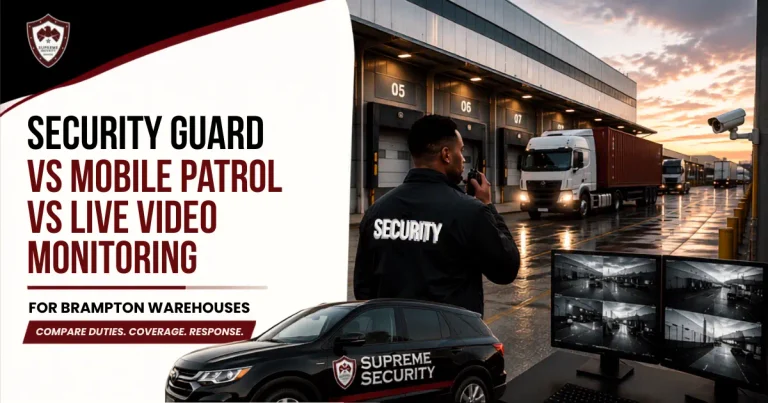
A warehouse security checklist should follow the complete movement of a person, truck or trailer through the property. The gate record, dock assignment, yard location and release record need to describe the same movement. If one part does not match, staff need a safe way to pause the event and contact the right decision-maker.
That matters in Vaughan, where warehouse and distribution properties connect directly to major goods-movement routes. City economic-development sources identify access to Highways 427, 400 and 407, CN MacMillan Yard, the CPKC Vaughan Intermodal Terminal and the Vaughan Enterprise Zone. These links support a busy logistics sector; they do not prove that any individual facility faces a particular crime level. Vaughan location and market access
Use this checklist to review gates, drivers, vehicles, trailers, seals, loading bays, yard visibility, cameras, patrol duties and incident records. Adapt it to the site’s actual carriers, shifts, contracts and legal requirements.
This is a security-planning resource. Qualified warehouse, maintenance and safety personnel should handle dock machinery, vehicle restraints, forklifts, trailer movement and occupational hazards.
Quick Answer: What Should a Warehouse Security Checklist Cover?
It should cover site zones, driver and vehicle verification, appointments, tractor and trailer identifiers, dock assignments, trailer status, seal records where applicable, gates, fencing, lighting, cameras, patrols and incident response. Every movement should connect to an authorized person, shipment, work order or property task.
Rate each finding:
| Rating | Meaning | Next step |
|---|---|---|
| Immediate attention | A current condition creates a serious security or safety concern | Pause the affected activity safely, notify the responsible manager and place an approved temporary control |
| Planned correction | A control exists but needs repair, clearer instructions or approved spending | Assign an owner and due date |
| Monitor | No current failure was found, but the item can change | Set a test or review date |
Do not mark a control as passed because equipment exists. An active gate can admit the wrong truck. A working camera can miss a trailer identifier at night. A detailed spreadsheet can still disagree with the physical yard.
1\. Map the Warehouse’s Security and Custody Zones
Start with the operation, not the security product. Two Vaughan warehouses of similar size can have very different risks when one runs scheduled daytime receiving and the other handles drop trailers across several shifts.
Record the operating profile
Document the facts that shape access and response:
- Active vehicle and pedestrian gates
- Number and use of loading bays
- Shipping, receiving and quiet periods
- Carriers and contractor types
- Drop-and-hook activity
- Yard tractors or spotters
- Driver waiting and dispatch areas
- Employee and visitor parking
- Empty, loaded and held-trailer zones
- Periods with no warehouse manager on site
- Security provider and monitoring responsibilities
Use ranges for public-facing planning where exact schedules would expose sensitive activity. Keep detailed operating windows in restricted site instructions.
Separate public, controlled and restricted areas
A visitor reception area may be public during office hours. A gatehouse lane is controlled. Trailer rows, active loading bays, inventory cages, camera equipment and mechanical rooms are restricted.
Map the route between those zones. A driver may be authorized to enter the yard but not the warehouse floor. A contractor may be approved for one dock door but not nearby staging areas. Access should reflect the job, not simply the fact that someone was admitted at the gate.
Mark each change of custody
Cargo and equipment can change hands several times:
- Carrier reaches the gate.
- Gate or dispatch checks the expected movement.
- Trailer enters the yard.
- Yard staff assign or change its location.
- Shipping or receiving accepts it at the dock.
- Loading or unloading finishes.
- An authorized party releases the trailer.
- Gate records the exit.
Name the record owner at each point. A gap between gate entry and dock acceptance is still a gap even when both teams completed their own paperwork.
Assign owners before an incident
| Control | Daily owner | Exception decision-maker | After-hours contact | Last review |
|---|---|---|---|---|
| Driver entry | ||||
| Dock assignment | ||||
| Trailer status | ||||
| Seal discrepancy | ||||
| Yard patrol | ||||
| Camera footage |
Blank cells show where warehouse, carrier and security responsibilities may collide.
2\. Verify Drivers, Vehicles and Appointments at the Gate
An ID check confirms identity. It does not confirm that the person, carrier, truck and shipment belong together.
Match the driver to an expected movement
Gate or shipping staff should compare the information required by the site’s approved policy:
- Driver name or authorized identifier
- Carrier
- Expected appointment or pickup
- Tractor unit or plate
- Trailer or container number
- Shipping or receiving contact
- Assigned destination inside the property
The warehouse should decide which role can approve a discrepancy. A security guard may collect and compare information but should not authorize a shipment or interpret cargo documents outside written authority.
Record tractors and trailers separately
A replacement tractor can arrive with the expected trailer. A carrier can send the expected driver with a different trailer. A single “vehicle number” field may hide that difference.
Record the tractor unit or plate and the trailer or container identifier separately. Where the site uses yard tractors, link the movement to the authorized operator or work record.
Control unscheduled and changed arrivals
Create a short exception path for:
- Early or late arrival
- Replacement driver
- Changed tractor or trailer
- Carrier substitution
- Missing appointment
- Driver sent to the wrong facility
- Pickup reference that does not match
Verify the change through a known company, customer or carrier contact. Do not rely only on a phone number supplied at the gate.
Restrict movement after entry
Admission to the property should not grant open movement. Give drivers a defined waiting area, dispatch point, washroom route and dock path. State whether an escort is required and what happens if someone leaves the approved area.
Collect only the personal information the approved process requires. Restrict access to gate logs and set a documented retention period that reflects the record’s purpose and applicable obligations.
3\. Keep the Trailer and Yard Inventory Current
The yard record should match the physical property. Reconcile it at shift change, after peak movement periods and whenever a discrepancy is reported.
Give every trailer a status and location
Useful statuses may include:
- Awaiting dock
- At dock
- Loading or unloading
- Loaded
- Empty
- On hold
- Released for pickup
- Maintenance or out of service
Record the dock, row or approved position. Avoid vague locations such as “back yard” when the property has several trailer lines.
Log movements, not only arrivals and departures
A trailer may move from the gate to a staging row, then to a dock, then to a hold area before exit. Log the movement time, former location, new location and authorized operator or reference.
This creates a usable history when the trailer is not where the system expects it to be.
Reconcile the yard at shift handover
Compare the physical identifiers and positions against the operating record. Flag:
- Trailer not found in its assigned position
- Trailer present but missing from the record
- Wrong status
- Unidentified tractor, trailer, container or chassis
- Loaded trailer recorded as empty
- Released trailer still on site
- Trailer at an unapproved dock or row
Security personnel can observe identifiers and external conditions. They should not enter a trailer showing damage or suspected tampering, move equipment or inspect mechanical condition.
4\. Control Trailer Seals and Cargo-Custody Records
Seal requirements depend on the shipment, customer, carrier, cargo and applicable program. Do not copy one cross-border rule into every domestic warehouse procedure.
Decide which loads require seal records
The site policy should identify when staff must record a seal, who may apply or remove it and which document contains the authorized number.
The CBSA Partners in Protection program is voluntary and limited to eligible members. Where PIP applies, CBSA Memorandum D23-1-1 addresses written seal policies, authorized application, inventory control, verification at custody transfers, discrepancy reporting and corrective records.
PIP requirements should be labelled as PIP requirements. They are not a universal legal rule for every trailer at every Vaughan warehouse.
Compare the seal with authorized records
Where a seal check applies, record:
- Trailer or container identifier
- Visible seal number
- Number shown on the authorized document
- Date, time and location
- Person making the approved check
- Match, mismatch, damage or missing status
A staff member should not open the trailer to settle a mismatch. Pause the affected movement and contact the authorized warehouse, carrier or customs lead.
Control unused and replacement seals
Limit access to unused seals. Track issue, return, void and replacement events under the company’s approved policy. A loose collection of unassigned seals weakens the value of the seal record.
If a seal is missing, damaged, altered or incorrect, document the visible condition and follow the site’s escalation requirements. Record any replacement number and the person authorized to apply it.
5\. Secure Loading Docks and Shipping/Receiving Handoffs
The dock is where gate information, trailer identity, warehouse work and cargo custody meet. The security check should support that handoff without replacing shipping or safety responsibilities.
Match the trailer to the assigned dock
Before the movement proceeds under the site’s policy, compare:
- Trailer or container number
- Assigned dock
- Appointment or work reference
- Current yard status
- Authorized carrier or yard operator
Record and escalate a mismatch. Security should not decide that the “close enough” trailer can be loaded.
Control pedestrian entry at the dock line
Drivers, couriers, mechanics, cleaners and visitors may reach the same exterior area for different reasons. Define their permitted waiting, walking and work zones.
Keep pedestrian rules aligned with the facility’s safety plan. Security staff should not stand between moving vehicles, direct reversing trucks from an unsafe position or enter forklift paths outside their assigned and trained role.
Secure inactive doors and temporary credentials
List active, inactive and maintenance dock doors. A door that is not scheduled for shipping still needs an owner, closed-state check and fault response.
Record dock keys, temporary badges, remote controls or other access devices issued to contractors and drivers. Each item should have a named recipient, issue time, permitted area and return record.
Record the handoff
The custody timeline should show when:
- Gate admitted the movement
- Yard assigned the trailer
- Dock accepted it
- Loading or unloading finished
- Shipping or receiving approved release
- Trailer left the gate
When these records use different systems, synchronize clocks and agree on the reference that ties them together.
6\. Check Gates, Fences, Blind Zones and Night Visibility
“Perimeter secure” is not a useful patrol entry. Divide the property edge and yard into named zones.
Review normal gate operation and exceptions
Test gate operation through approved vendor or management instructions. Confirm who responds to:
- Gate stuck open or closed
- Failed reader or intercom
- Vehicle tailgating
- Driver at the wrong gate
- Emergency access request
- Power or communication outage
- Manual override request
Technical repairs and life-safety decisions belong to qualified personnel.
Walk the fence and property edge
From a safe position, record visible damage, openings, blocked views, material stacked near the fence and unplanned access from adjoining property. Use clear zone names and maintenance references.
Trailers and containers move, so a clear view today may become a blind zone tomorrow. Keep the detailed blind-zone map private. Update camera and patrol instructions when the yard layout changes.
Review lighting when the yard is dark
York Regional Police advises businesses to keep entrances, parking and loading zones well lit and clear, maintain cameras, alarms and access controls, secure closed areas, train staff and review security plans. YRP business crime-prevention guidance
Check gates, the dock face, trailer rows, employee parking and pedestrian routes under actual night conditions. Record failed lights, glare, heavy shadows and obstructions. In winter, snow storage can block a light, camera or view even when the equipment works.
7\. Test Cameras, Access Logs, Alarms and Evidence Retrieval
The warehouse needs more than a live camera wall. It needs records that can reconstruct an event.
Give each camera a defined job
The private camera schedule should state which event each view is meant to capture: gate entry, dock arrival, trailer row movement, pedestrian access or a perimeter crossing.
Test the view using actual distance, angle, speed and lighting. Do not accept a vendor claim that a camera can always read a plate, badge, trailer number or label at a fixed distance. Site conditions decide whether the image is useful.
Synchronize time across systems
Compare the clocks used by:
- Cameras and recorders
- Gate logs
- Card access
- Alarm events
- Yard records
- Shipping and receiving systems
A few minutes of difference can place a person, trailer and shipment in the wrong sequence.
Control access and retention
Name the roles allowed to view or export footage and logs. Record the reason for access, the material disclosed and the receiving party.
The Office of the Privacy Commissioner of Canada advises private organizations to limit collection, post notice, restrict access and keep recordings only as long as needed for their stated purpose. Review its video-surveillance guidance when writing the property policy.
No single retention period fits every warehouse. Consider the record’s purpose, contracts, applicable requirements and qualified privacy or legal advice.
Test incident retrieval
Choose an authorized past event and try to build its timeline. Can the manager find:
- Gate entry
- Driver and vehicle record
- Trailer movement
- Dock assignment
- Relevant camera footage
- Access or alarm event
- Exit or hold status
Record missing or inconsistent elements as findings. A successful live view does not prove that staff can retrieve yesterday’s event.
8\. Define Guard, Gatehouse, Patrol and Monitoring Duties
Start with the decisions and checks the warehouse needs. Then choose the service model.
Gatehouse guard
A continuous post may fit a facility that admits drivers and vehicles across several shifts. Written duties can include entry comparison, exception routing, key control, communication and gate records.
The guard should not approve cargo, change shipment instructions or make customs decisions unless the employer has granted that authority and the person has the required training.
Yard patrol
An on-property patrol can check named gates, dock doors, trailer rows, fencing, parking and other approved zones. The record should state the location, observable condition, exception, action and person notified.
“All clear” does not show what was checked.
Mobile patrol
Mobile patrol may fit a closed or quiet facility that needs physical visits at selected periods. It does not provide continuous gate control or a person between visits.
Keep exact timing restricted. Give the patrol clear zones, exception rules and a response contact.
Video monitoring
Live monitoring can review defined camera events and contact a responder. It sees only covered areas and creates no physical presence on its own.
The contract should state which alerts are reviewed, during what period, what counts as an actionable event and who receives the escalation.
Compare coverage by task
| Requirement | Gatehouse guard | Yard patrol | Mobile patrol | Video monitoring |
|---|---|---|---|---|
| Continuous vehicle-entry decision | Strong fit | Limited | No | Depends on remote gate setup |
| Physical trailer-row check | Possible | Strong fit | Visit basis | Camera field only |
| Wide perimeter observation | Depends on staffing | Strong fit | Visit basis | Depends on camera coverage |
| Immediate physical presence | At the gate | On property | Dispatch/visit basis | None |
| Camera-alert review | Possible | Limited | Limited | Strong fit |
Combined coverage can work when roles are distinct. Avoid paying two providers for the same observation while nobody owns the response.
9\. Control Shift Changes and After-Hours Exceptions
Handover should carry current site conditions, not just completed tasks.
Record:
- Expected early or late drivers
- Replacement drivers or vehicles awaiting approval
- Open gates or dock faults
- Camera, alarm or communication outages
- Trailers on hold
- Seal or document discrepancies
- Contractors still on site
- Police or maintenance events
- Actions awaiting management
Reconcile open gates, inactive dock doors and trailer status before the outgoing shift leaves. If the physical state does not match the record, assign the discrepancy rather than passing it forward as an informal note.
Weekend and holiday instructions may need different contacts and shipping rules. Remove temporary instructions and credentials when normal operations resume.
10\. Respond to Discrepancies and Preserve Evidence
The response should protect people first and prevent an unverified movement from continuing.
Pause safely within the person’s authority
A gate officer may hold entry under written site rules. A shipping manager may place a trailer on hold. A camera operator may contact the named responder. Each role needs a clear limit.
Do not physically block a moving vehicle, enter a suspected tampered trailer or confront a person beyond training and safe working conditions.
Verify through known contacts
Use approved company, carrier or customer records, not only information presented by the driver. Document who confirmed the change and at what time.
Call 911 for a crime in progress or immediate danger. York Regional Police lists 1-866-876-5423 as its non-emergency number; confirm current contact details on the YRP website when preparing printed instructions.
Build an objective incident record
Capture:
- Date and synchronized time
- Exact gate, dock or yard zone
- Authorized driver and carrier information
- Tractor and trailer identifiers
- Appointment or shipment reference
- Seal number or discrepancy where applicable
- What the writer directly observed
- Action taken
- Contacts and times
- Camera, access and log references
- Police occurrence number when provided
- Follow-up owner and due date
Separate observation from assumption. “Trailer 123 was at Row C instead of its recorded Dock 8 position” is stronger than “someone tried to steal the trailer” when intent is unknown.
After the immediate event, reconcile the gate, yard, dock, seal, access and camera records. Identify the first control that failed or the first record that drifted.
11\. Turn Findings Into an Action Register
A checklist becomes useful when each finding reaches an owner.
Separate work by responsibility
Warehouse operations may own appointments, dock assignments, yard status and shipment release.
Security may own entry comparison, patrols, key control and incident records.
Maintenance or technical teams may own lighting, gates, fencing, doors, cameras and readers.
Management or procurement may own coverage hours, contracts and capital approval.
Use one action table
| Finding | Zone | Priority | Safe temporary action | Permanent action | Owner | Due date |
|---|---|---|---|---|---|---|
| Example: trailer record differs from physical row | Yard Row C | Immediate attention | Place movement on approved hold and reconcile identifiers | Correct movement workflow and shift-handover check | Yard manager |
Review old findings at the next assessment. An interim guard post, temporary camera or manual log should not become permanent without a decision.
12\. Prepare a Clear Security-Coverage Brief
If the checklist identifies work for a security provider, give every bidder the same scope:
- Site and yard layout
- Active gates and dock doors
- Shifts and shipping windows
- Expected driver and vehicle volume ranges
- Gatehouse comparison duties
- Patrol zones
- Camera-monitoring events
- Exception and incident steps
- Report format and timing
- Supervisor and replacement coverage
- Temporary, seasonal or ongoing term
Do not share customer lists, cargo values, exact blind zones, access credentials or high-value shipment schedules in an early quote request.
Compare what each provider will do, who supervises it, what happens after a finding and what the report will show. Once the related article is live, link this section to How to Compare Security Guard Quotes in Vaughan.
When Professional Warehouse Security Coverage May Be Needed
Outside support may be worth reviewing when:
- Gate decisions continue across several shifts
- Driver or vehicle discrepancies repeat
- Trailer inventory cannot be reconciled
- Loaded, empty and held trailers lack clear separation
- Several gates or dock areas require physical checks
- Camera alerts have no responder
- Blind zones change as equipment moves
- Patrol reports do not support follow-up
- Contractors receive inconsistent access
- Management needs one after-hours escalation path
Bring the site map, shift profile, current records, incident summary and action register to the discussion. Supreme Security Services provides guards, mobile patrol and monitored-camera support for managed properties. Review its Vaughan security services for industrial properties and request a site discussion based on the duties your warehouse has identified.
Frequently Asked Questions
What should a warehouse security checklist include?
It should include gates, people, vehicles, trailers, loading bays, yard zones, perimeter conditions, cameras, access records, patrols and incident response. Every movement should connect to an authorized person, shipment or work task.
What should a gatehouse verify before admitting a driver?
Compare the driver or authorized identifier, carrier, tractor, trailer, appointment and destination against an expected movement. Route any mismatch to the authorized warehouse or shipping contact. Security should not approve cargo documents outside written authority.
How should a warehouse track trailers in the yard?
Record the trailer identifier, current status, assigned location, last movement and release status. Reconcile the digital or paper record against the physical yard at shift handover and after high-movement periods.
Do all trailers need high-security seals?
No universal rule applies to every trailer. Requirements can depend on CBSA PIP membership, cross-border status, customer policy, carrier rules, cargo type and other obligations. Identify the applicable requirement before writing the site procedure.
What should staff do if a seal number does not match?
Pause the affected movement safely. Do not open the trailer. Contact authorized warehouse, carrier or customs personnel, document the discrepancy and follow the applicable reporting requirement.
How often should warehouse yard patrols occur?
There is no universal frequency. Base it on the site size, shifts, active gates, trailer movement, incident history and required response. Keep exact patrol timing in restricted site instructions.
Can cameras replace a warehouse security guard?
Not in every case. Cameras observe covered areas and need a response path. They cannot independently verify every driver record, inspect an area outside their view or create physical presence at the gate.
Should security guards inspect loading-dock equipment?
Guards may report obvious damage or abnormal conditions from a safe position. Qualified warehouse, maintenance and safety personnel should inspect dock machinery, restraints and operating equipment.
What records help investigate a warehouse incident?
Useful records may include synchronized camera footage, gate logs, driver and vehicle data, trailer-location history, seal records where applicable, access events, shipping references, incident reports and contact times.
What should a Vaughan warehouse include in a security quote request?
Include the zones, gates, dock activity, shifts, duties, patrol requirements, monitoring response, reporting, supervision and replacement expectations. Keep cargo values, credentials and sensitive movement details restricted.
Set the Next Dock or Yard Security Priority
Map the site. Compare expected drivers and vehicles. Reconcile the yard. Test whether gate, dock, camera and access records describe the same event.
Then assign each gap to warehouse operations, security, maintenance or management. If outside coverage is needed, request it against defined duties, not a vague instruction to “watch the warehouse.”