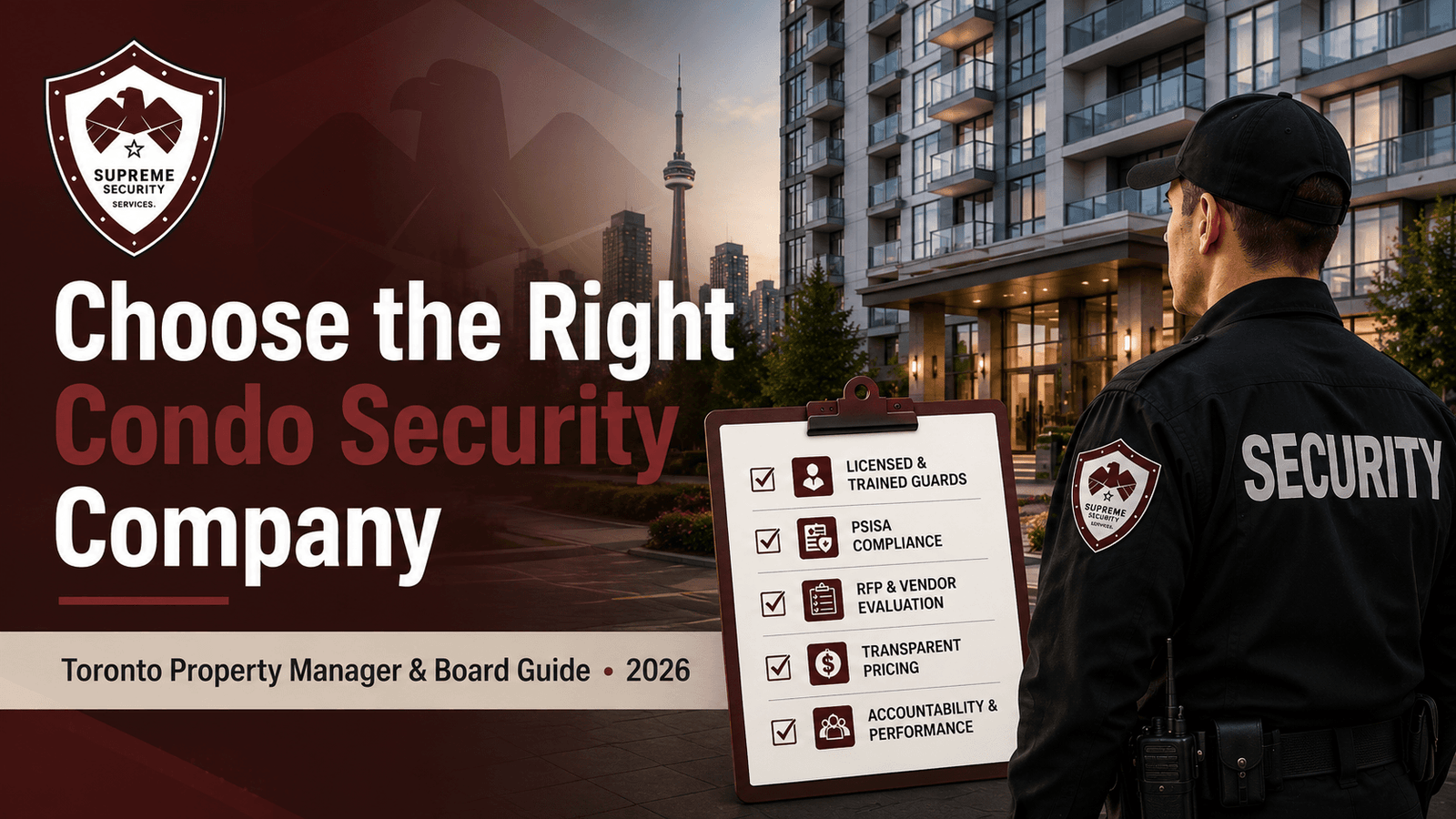
The Complete Property Manager & Board Guide (2026)
Choosing a condo security company in Toronto is not a simple service purchase. It is a procurement decision your board must document, and a liability decision that follows every director who signs the contract. Most guides online rank a list of providers or repeat a generic checklist. Few explain the actual rules your board has to follow, or what a fair contract should cost in 2026.
This guide fixes that. It walks property managers and condo boards through the licensing standard every guard must meet, the procurement obligations tied to the Condominium Act, a scoring framework for your RFP, and real GTA pricing so you can tell a fair quote from a risky one.
What Counts as Condo Security in Toronto?
Condo security is a licensed guard, concierge, or patrol service that a condominium corporation hires to protect residents, staff, and common property. In Ontario, every guard assigned to that contract must hold a valid licence under the Private Security and Investigative Services Act, 2005, known as PSISA.
For a Toronto condo, that usually means one or more of the following: front desk concierge coverage, controlled access management, mobile or static patrol of common areas and garages, live video monitoring, and emergency response coordination with the board and property manager. The service your building needs depends on its layout, resident profile, and past incident history, not a one size fits all package.
Is Choosing a Security Company a Legal Procurement Decision?
Yes. Under the Condominium Act, your board has a fiduciary duty to manage corporation funds responsibly, and hiring a security vendor counts as procurement, not a casual purchase. The Condominium Authority of Ontario‘s guide on procuring goods and services treats security contracts as an operational project, the kind of purchase that renews regularly and should go through a documented bidding process rather than an informal handshake renewal.
One detail most boards miss: under Section 97 of the Condominium Act, a change is a “substantial change” if its estimated cost exceeds the lesser of 10 percent of your annual budgeted common expenses or a prescribed amount. A substantial change cannot proceed unless at least 66⅔ percent of owners vote in favour of it at a properly called meeting, which is a materially harder bar to clear than a simple board decision. Ask your condo manager to confirm whether a new security contract crosses this threshold before you sign anything, because starting an RFP without knowing this changes your entire timeline.
Conflicts of interest matter here too. The CMRAO’s practice guide for condominium managers requires any real or perceived conflict, such as a board member’s family connection to a bidding vendor, to be disclosed in writing and recorded in the meeting minutes. A clean paper trail protects your board if a losing bidder ever challenges the process.
What Licence Must Every Guard on Your Site Carry?
Every security guard working in Ontario must complete a government approved 40 hour training course and pass a licensing exam before receiving a PSISA licence. Licences are digital only now, so ask your vendor to show you the licence number for each guard, not just a physical ID card.
Since February 18, 2024, every new and renewal application also requires a Criminal Record and Judicial Matters Check completed by a police service, a deeper background check than the older criminal record check it replaced. Guards must also hold current First Aid and CPR certification, and complete Use of Force training appropriate to their duties.
As of mid-2026, the province has an active consultation underway on possible changes to background check rules and licensing oversight under PSISA. Your RFP should ask each vendor how they plan to stay compliant if those rules shift, rather than assuming today’s standard will stay fixed. A vendor who cannot answer that question in detail is telling you something important about how closely they track their own compliance.
How Much Does Condo Security Cost in Toronto?
Standard unarmed guard services in Ontario typically bill in the range of $28 to $45 per hour in 2026, with concierge and event coverage often landing toward the higher end of that range. Specialized coverage, such as loss prevention or high risk event security, can run higher still.
Several factors are pushing rates up this year. Ontario’s general minimum wage rises from $17.60 to $17.95 per hour on October 1, 2026, and that base wage increase flows straight into every vendor’s bill rate on top of CPP, EI, and WSIB premiums. Liability insurance costs have also risen across the security industry, and that gets reflected in the bill rate you receive.
The lowest quote is rarely the safest choice. A rate well below market usually means a vendor is cutting corners somewhere: undertrained guards, high turnover, thin insurance coverage, or unpaid on call breaks that create their own compliance risk. Ask any vendor quoting below market to walk you through their cost breakdown before you sign.
What Should Your RFP Require From Vendors?
A strong RFP scores vendors on more than price. It asks for proof of licensing, insurance, guard turnover, response time, technology, and references, then weighs price against that full picture rather than in isolation.
| Evaluation Criteria | What to Ask For | Why It Matters |
| Licensing proof | Current PSISA licence numbers for every guard proposed for your site | Confirms legal eligibility before a guard ever starts a shift |
| Insurance and WSIB | Certificate of liability insurance and a WSIB clearance certificate | Protects your corporation if a guard is injured or causes damage |
| Guard turnover rate | Average annual turnover on comparable condo sites | High turnover means less familiarity with your building and residents |
| Response time | Written average response time for incidents and dispatch escalation | Directly affects resident safety in an emergency |
| Technology and reporting | A sample incident report, patrol log, or access control audit trail | Shows the board what visibility it will actually get |
| References | Two or more condo board references, not property managers alone | Boards can speak to procurement and contract experience directly |
| Price transparency | A full rate breakdown, not a single blended hourly number | Surfaces hidden fees before they show up mid contract |
Score each vendor against this table before your board votes. A documented scorecard also gives you a clean record if an unsuccessful bidder ever asks why they were not selected.
What Red Flags Should Disqualify a Vendor Immediately?
Some warning signs should end a vendor’s candidacy before you even reach the pricing conversation. An unlicensed guard on a proposed roster is one of them, since it exposes your corporation to direct liability under PSISA.
Watch for a vendor who cannot produce a current insurance certificate on request, or who has no condo board references at all. Rigid, one size fits all packages are another concern, since your building’s risks are not identical to a commercial office tower’s. Hidden fees that surface only after the contract is signed are the clearest sign to walk away.
How One Board Weighed Price Against Risk
Here is a hypothetical scenario that illustrates the stakes. A 220 unit condominium board in Vaughan received three quotes to replace its long standing concierge provider. The lowest bid came in nearly 20 percent under the other two.
When the board asked for the vendor’s guard turnover rate and insurance certificate, the answers were vague, and the reference list included only the property management company, not a single condo board. The board chose the mid priced vendor instead, one who provided a full RFP scorecard response, verified PSISA numbers for every proposed guard, and two condo board references who confirmed low turnover over three years. The price difference was modest. The liability difference was not.
When Should Your Board Start the Vetting Process?
Start the RFP process at least 90 days before your current contract expires, and ideally before your AGM so the board can present a clear recommendation to owners if the contract counts as a substantial change requiring a 66⅔ percent vote. Waiting until the last month leaves no time to properly score vendors, negotiate terms, or arrange an owners’ meeting if one turns out to be required.
Tie your review to your reserve fund and annual budget cycle where possible. That timing lets your board weigh a new security contract against other planned expenses, rather than approving it in isolation under time pressure.
Getting Started
A condo security contract is one of the more consequential decisions your board will make this year, both for resident safety and for your corporation’s liability exposure. If your board wants a licensing check, an RFP scorecard reviewed, or a straightforward proposal for concierge security services, request a quote and we will walk your board through it directly.
Frequently Asked Questions
How much does condo security cost in Toronto?
Standard unarmed guard and concierge services typically bill between $28 and $45 per hour in 2026. Specialized coverage such as event or loss prevention security can cost more, and boards should always ask for a full rate breakdown rather than one blended number.
Do security guards need to be licensed in Ontario?
Yes. Every guard must complete a 40 hour training course, pass an exam, and hold a valid digital PSISA licence before working on your site. Since February 2024, licensing also requires a Criminal Record and Judicial Matters Check completed by a police service.
What is a substantial change under the Condominium Act?
It is a cost that exceeds the lesser of 10 percent of your annual budgeted common expenses or a prescribed amount. A security contract that meets this threshold requires the approval of at least 66⅔ percent of owners voting at a properly called meeting before your board can proceed.
Can our board switch security companies before the current contract ends?
It depends on the termination clause in your existing agreement. Review the notice period and any early termination fees with your condo manager before starting a new RFP.
How do we verify a security guard’s licence?
Ask the vendor for the digital PSISA licence number for each guard assigned to your site. Physical ID alone is not sufficient confirmation under current licensing rules.
How quickly can a new provider deploy guards to our building?
Timelines vary by vendor and staffing levels, but a well run provider should give you a written deployment date as part of their proposal, not a vague estimate after the contract is signed.